Religion, academics, and fisheries policy

I once explained to a non-Dutch economist how religion affects Dutch fisheries policy and she could hardly believe me. Here is a post from a fisherman from Urk, The Netherlands’ biggest fishing community, that perfectly illustrates how deep this impact goes, and how it complicates fisheries policy.

If you can’t read Dutch, let me translate the gist of the piece (hyperlinks added for clarification):

Last Monday we were fishing on the East side of the Cleaver Bank. This is one of the areas our green friends of Greenpeace claim is an important nature reserve, making their point by dumping a bunch of stones. Catches were great until the wind turned and our catch suddenly reduced to about half of what we were catching. I’ve seen this happening before, and I used to ask older fishers: “The fish has to be somewhere, right? It can’t just disappear, can it?” And all they could answer was that they just did not know. It makes you wonder who we think we are to think we can exert any influence on the fish. You won’t convince me that we, with our small boats, are capable of destroying the entire sea bottom as so many folks say we do.

Nature is so great, it does not care about what we do, it goes its own way and the way planned by its Creator. Man’s activities could change that a bit on the short term but it will not establish real change. There is fish, or there is no fish, but where it comes from or where it goes nobody knows. There have been bad times and there have been good times. You can’t express it in some graph that needs to be interpreted so that some policy can be implemented. You can’t confine Nature in little boxes such as the Plaice Box. It is impossible to understand Nature, and more difficult to predict than the weather.

We can do our job every week in that Creation, to enjoy its diversity, to which we sometimes pay too little attention. Our sights are obscured by our everyday financial troubles but all the while we can enjoy the greatest masterpiece of all times, God’s Nature.

We can run all the models we like, do all the estimations we like, but any attempt to limit catch or fishing effort will at best be grudgingly accepted by somebody with this world view.

So who’s right? I’m tempted to side with the biologists and to say they should try better at convincing the fishers, but I won’t, for two reasons. First, I find that a paternalist approach that can only antagonize people, and one of things most lacking in fisheries policy is mutual trust. Second, even the biologists themselves admit they don’t know everything so I think a two-way communication would be much more helpful. Yes, we might learn a thing or two from the fishers.

Fisheries policy has all the ingredients of a policy maker’s nightmare. Like climate policy, fisheries management is dazzlingly complex, with a lot of unknowns. The Plaice Box was established to protect juvenile plaice, thereby improving the entire flatfish fisheries. The fishers hated it and did not expect any good from it. Ever since its establishment, its stocks of juvenile plaice have declined! The biologists are still in the dark why, but the fishers feel vindicated.

Moreover, there is a huge gap in world view and education between the sector (religious, vocational training) and the researchers (secular, PhD). I know of nobody who ever crossed that rift. In Wageningen you meet many academics who come from a non-academic background: many of my colleagues and students were born and raised on a farm, and I myself was born right above my father’s butchery. I think a lot of agricultural policy would not have been possible without people who knew both worlds. But I have never met any student in, say, animal husbandry, biology, or marine resource management whose father went out on a fishing vessel every week.

Lastly, there are institutional problems, and history has not been helpful here. Fish stocks have been a free-for-all for centuries, with all the known commons problems, but also establishing a sense of entitlement among fishers. It is their fish, it is their fishing area. Sadly, the moral entitlement has not been joined by a legal one: a farmer may own land, but a fisher has no legal tenure over any area in the North Sea. So legally the government can designate huge no-take zones without having to compensate anybody, but doing that on land involves huge costs in buying land or compensating people.

Man, I love my job (had a nice raw herring with onions yesterday).
Why economists argue with ecologists (3): consequences versus deontology

A fundamental difference between economists and ecologists is that economists tend to approach environmental pollution as an allocative issue, whereas ecologists tend to approach it as a moral issue. Or, more accurately, economists take a consequentialist approach whereas ecologists tend to be more deontologist.

There are many examples to illustrate this, but none is as sharp as the debate on emissions trading. It used to be no more than a smart idea to limit pollution in an efficient manner, but it has evolved into a political minefield where the Left sees it as a sell-out to Wall Street, whereas the Right sees it as a communist takeover of the economy. The idea is simple: we limit emissions to, say, 100 units, and so we distribute 100 units of emission rights among polluters. Want to pollute more? Then buy rights from another polluter, who will then have to take additional emission reduction measures. You bet he will only agree to that transaction if you pay him more for his right to pollute than it costs him to reduce his pollution by one additional unit. Moreover, you will only agree if the price you pay for the right is lower than it benefits you to increase your pollution. In other words, you can have a voluntary transaction that makes both parties better off without further damaging the environment. This is a way of achieving what economists call allocative efficiency: we shuffle around resources and other inputs to achieve the maximum output at minimum costs, where costs include environmental damage as well as wages and all. An economist would say: we have the same environmental quality, but we increase welfare – what’s not to like?

A lot, an ecologist would say. Besides issues with regard to enforcement, windfall profits, etc., an ecologist would also have objections of a moral nature. Here are a few of the objections I’ve heard from students and researchers:

  • How can you give somebody a right to pollute? Nobody should have any right to pollute the environment.
  • Under such schemes companies can just pay some money and go about their dirty business. They should give a good example to others.
  • It’s immoral to commodify the environment.
  • Tradable emission permits are a modern version of medieval indulgences.

I can think of a lot of misguided objections to emissions trading, but these objections are not among them. They are moral objections that are valid within a given moral framework, which may not be my moral framework, but a valid one nonetheless. You hear similar arguments in the debate on economic valuation of the environment, biotechnology, and to some extent Payments for Ecosystem Services (wait until you propose hunting as a source of conservation funding). In all of these examples economists stress the allocative issue: “look, we clean up the environment right? That’s what you want, right? So why not make sure that we do this efficiently through emissions trading / cost-benefit analysis / GMOs / hunting concessions?” On the other hand, ecologists tend to stress the moral side of the issue: “rights to pollute / pricing nature / genetic modification / hunting is plain wrong and we shouldn’t do it.”

Beneath the economist’s allocative approach lies the philosophy of utilitarianism. In a nutshell, utilitarians argue that an action is morally right whenever it maximizes the sum of all happiness. This also means that utilitarians judge an action purely by its consequences, whereas other moral philosophies (also called deontological ethics) judge the action itself.

In other words, economists take a consequentialist approach to environmental problems, whereas ecologists tend to be more on the deontological side. Note that the moral objections to emissions trading listed above focus on the trading itself rather than its consequences. The economist’s reply will always point to the consequences.

Maybe it is due to my economics training, but I’m more on the consequentialist/utilitarian side. The deontological argument can become self-defeating, for instance when opposition to hunting leads to habitat degradation. If we have to choose between an ailing population of an endangered species without hunting and a thriving population that pays for its own conservation through hunting, I’d choose hunting anytime.

A temptation if there ever was one

Just got this in my inbox:

This is to inform you that Techno-Press, a global publishers of Engineering Journals, has started a new journal with a title;

“Advances in Environmental Research (AER)”,
An International Journal of Multidisciplinary Research in Environmental Science, Technology and Management.

Naah, too easy.

At least they read my CV

Just got this in my mailbox:

Dear Rolf Adriaan Groeneveld,

As stated by the Wageningen Agricultural University’s electronic repository, you authored the work entitled “development of a bioeconomic fisheries model with predatory relations between species” in 2000 within the framework of your postgraduate degree.
Due to the fact that we are currently planning publications in this subject field, we would be pleased to know whether you would be interested in publishing the work mentioned above with us.

LAP LAMBERT Academic Publishing is a member of an international publishing group which has almost 10 years of experience in the publication of high-quality research works from well-known institutions across the globe.
Besides producing printed scientific books, we also market them actively through more than 80,000 booksellers.

Kindly confirm your interest in receiving more detailed information in this respect.

I am looking forward to hearing from you.

Best regards,

Laura Dean
Acquisition Editor

(address, telephone number, etc)

My first reaction: “Huh? Did I write that?” My reaction after some googling: “Oh. That’s how I describe my minor thesis in my CV.” My reaction after some more googling and finding this: “Better not.”

Honestly, I get loads of garbage like this lately.

(Edited 21 May 2012 to remove contact info)

Seeing red about diesel

It’s just unbelievable. VVD (sort-of-libertarian), CDA (christian centrist) and PVV (right-wing populist) just spent weeks haggling over a new budget. Finally the whole thing blew up, we’re getting new elections in September, but in the meantime CDA and VVD managed to agree with a bunch of other parties, including the Green Left (yes, that’s their name) and the sort-of-liberal D66, within 48 hours. Was it really that easy? What have they been doing in those past weeks?

Anyway, part of the deal is a tax increase on so-called ‘red diesel’, i.e. diesel with a lower tax rate than regular diesel. It is only allowed in such machines as tractors, road maintenance equipment – and all non-recreational ships. No wonder Dutch fishers are up in arms. Fuel is one of the major expenses of Dutch bottom trawlers.

I hate to say this, but as an economist I don’t see a reason to exempt any economic sector from a tax, let alone a tax on fossil fuels. If farmers and fishers pay a lower tax rate, why not trucks? Or salesmen? As we’re on it, why not abolish the tax altogether? Oh wait – there’s state coffers to fill and negative externalities to tax. But in any case, I think we should have a level playing field for all, and that includes a similar tax rate for all.

Stuff I do: Competing Claims on Natural Resources

Here is a project I like to tell students about to make them aware that conservation comes at a price. It was on Dutch television last summer:
http://s.nos.nl/swf/nieuwsuur_video_embed.swf?tcmid=tcm-5-940650

If you don’t understand Dutch: the project is called Competing Claims as it investigates conflicts between wildlife conservation and the livelihoods of local residents. To put it bluntly, it is very easy for a Dutch granola-munching environmental student to argue for conservation of elephants and lions, but if you’re a farmer near the park fence and you can hardly earn a decent living while elephants trample your crops and lions eat your cattle (or your son), you’re probably less than enthousiastic.

These conflicts are terribly difficult to solve, but one step in the right direction is to make explicit who is affected, how they are affected, how serious the effects are, and what tradeoffs are present. Economics can play a modest role in this by analysing those tradeoffs, and assessing economic impacts.

Here we go again

Kalle Lasn, founder and editor of Adbusters magazine, says in the latest edition of Solutions Journal:

“I predict we’re going to move away from large occupations of parks and we’ll have surprise, one-day occupations of banks and corporations and the economics departments of universities”

There you have it: banks, corporations, economists. All latter-day Scrooges. Further down the interview:

“I hope you tell [Herman Daly and Robert Costanza, founders of ecological economics] that from my perspective their ideas are reaching fruition, and I wish they would encourage their followers to be more aggressive. Suddenly, old and young people are pushing against the system and it’s time for ecological economists to stand up and be counted and not just play academic games in the background. Joseph Stiglitz actually went to Zuccotti Park and gave a talk. We need more of that. We need them to champion their paradigm.

We also don’t have full cost accounting. There is a dream among Occupiers to have a global market where products show their ecological cost, which would reflect their true cost. They will find that the price of cars goes up and bikes goes down. Maybe that McDonald’s napkin could suddenly have a certain price to it. And apples from New Zealand would have a different price. How much does all that stuff from China going to Walmart truly cost in environmental damage?”

Lasn’s “full cost accounting” is called a “Pigouvian tax” in any mainstream, neoclassical, economics text book. It’s really not that controversial.

I can refer to The Cure at the next EAERE conference

Anyone who had a radio in the 1980s should know these lyrics:

Misjudged your limits
Pushed you too far

It neatly describes my paper with Christopher Costello and Michael Springborn that has just been accepted for presentation at this year’s EAERE conference in Prague. The general idea of the paper is this: you are doing something you like, and the more intensively you do it the more you like it. There is a danger, however, of going too far, and if you go too far something nasty happens. Your problem is, you don’t know how far is too far. Will you stay on the safe side? Will you experiment to find out what ‘going too far’ actually means? How much will you experiment? When do you stop experimenting? And how does this all depend on what you already know, and the consequences of crossing the line? That is what the paper is about.

You may wonder what this has to do with the economics of ecosystems. There are several examples of ecosystems suddenly collapsing under man-made pressures such as pollution or exploitation. The most well-known example of this is the shallow lake. You can add phosphorus to a clear shallow lake without noticing any effects, until the phosphorus content crosses a line and the lake suddenly turns turbid. This regime shift, as ecologists call it, happens all of a sudden. It is not like your pasta boiling over, where you can turn the gas down to limit the damage when it happens. And it matters economically whether the lake is clear or turbid: swimmers, anglers and divers prefer clear lakes to turbid ones, so you could lose a lot of recreational values. Moreover, reversing the process is expensive: you need to reduce the phosphorus content to a level much lower than the level that triggered the shift to the turbid state. In many cases you also need to fish intensively for species like bream, because bream enhance the turbid state by stirring up the bottom when they look for food. (By the way, Wageningen University’s Mister Shallow Lake, Marten Scheffer, used to play in one of the most legendary Dutch folk bands.)

While working on the paper I realised the problem is actually quite general. The captain of the Costa Concordia faced a similar decision: the closer he got to the Giglio shore to make his salute, the more likely he was to run aground. In his case the consequences of “going too far” are huge: at this moment 30 passengers are confirmed dead while two are still missing.

On a lighter note, Robert Smith describes the same problem in those lines quoted above. I take it he spent just a tad too much time in the pub, at least more than he thought his girlfriend would accept. In some relationships this may cost no more than a box of chocolates, but in the song he loses his relationship altogether. At least he got a hit single out of that experience.

And now for something completely different

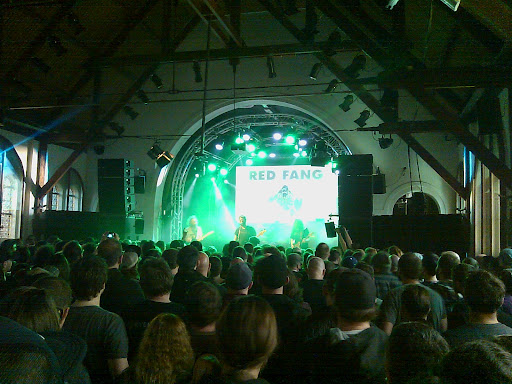
The picture on the right was taken on the first day of this year’s Roadburn festival. The venue you see is Het Patronaat (formerly an annex to the nearby catholic church) although most concerts are in 013. For lovers of psychedelic/sludge/stoner/post/doom/whatever rock, Roadburn is the place to be. I mostly prefer the stoner and desert rock bands (I still regret not having seen Fatso Jetson in their own café when I had the chance), but occasionally you see stuff you thought you’d hate but that turns out to be actually quite good. My revelation this year was Sleep, which I thought nothing special on CD but was very convincing on stage.

Another devout Roadburner

Getting a ticket to Roadburn is no easy task: last year tickets were sold out in 15 minutes when they came on sale at 10am CET. Nevertheless, it has a very international audience with visitors from all over Europe and even the United States. That’s right: some folks on the American east coast are willing to stay up at 4am to buy a ticket so they can cross the Atlantic Ocean to Roadburn.

One thing I have never understood though: does it really have to be this LOUD? I know the question sounds lame, but at some concerts at least half the audience wears earplugs. I also wear them – I mean, if you’re a music lover your ears should be precious to you. It’s not just about hearing loss, I once met somebody whose hyperacusis almost drove him to suicide. So why not put the volume down a bit?

Illegally obtained evidence in whaling research?

Apparently some biology journals refuse to publish research on whales if data for that research come from commercial whaling, as this paper in the ICES journal describes. Frankly the authors (all from a Norwegian research institute) are not happy with that.

I am no legal expert so I don’t know whether such research is a case of illegally or improperly obtained evidence. I understand why such evidence is not accepted in court: you don’t want to encourage police officers breaking the law themselves to catch a criminal. By the same token, you don’t want to encourage researchers breaking international treaties for their research.

Nevertheless, I have mixed feelings about the international whaling bans. I once made this picture on the Bergen Fish Market:

Yes, I tried whale meat. It’s not exactly a delicacy. I also asked what species it was and they told me it was minke whale. If you check minke whale in the IUCN Red List you will find the species is not threatened in any way. But what about the species next to the whale meat? There are many different eel species, but the eel you buy in most shops is European Eel – critically endangered, according to the IUCN Red List.

Why do we eat eel, which is on the brink of extinction, while we get so upset about minke whale, which is so abundant? I admit: smoked eel tastes much better than whale meat.