10 Good things about Canberra

When I told the lady of my B&B in Brisbane that I was going to Canberra, she looked puzzled: why do you want to go there? I’m in Sydney now, and when I told the bloke at my hotel’s reception that I had just come in from Canberra and all he said was: “I’m sorry.” Today somebody even apologised for Canberra!

Come on guys, it’s not that bad! Here is a list of good things about Canberra.

  1. No Few distractions. It is the perfect place to work on your research vision and your Python modelling skills.
  2. It’s supposedly one of the best places to spot kangaroos. There are so many of them that there are culling programs in place.
  3. It has four seasons, so you can enjoy Winter in July.
  4. There is no Starbucks. The Evil Mermaid has laid her greedy claws on places as beautiful as Ubud on Bali, the Cameron Highlands in Malaysia, and just about every street corner in downtown Santa Barbara, California, but so far Canberra has remained untainted by her presence.
  5. When you feel homesick, the shops have kale and the pubs serve bangers & mash, which is a little bit like a Dutch stamppot met worst. (Why aren’t Dutch pubs serving boerenkool met worst? It’s the perfect pub food!)
  6. There are a couple of decent Asian restaurants around, among which a vegetarian Vietnamese restaurant with delicious banh xeo.
  7. It has the Wig & Pen: a traditional brewpub with some delicious homebrewn beers.
  8. It might be just about the greenest city of Australia, with lots and lots of parks.
  9. It’s a good place to cycle: many bike paths, and reasonably good traffic. Sometimes it’s difficult to see where you’re supposed to cycle though.
  10. Sydney is not that far either, and it’s a beautiful train ride.

Judd and Guu’s stochastic perturbation model in Python

I just uploaded a Python version of Judd and Guu’s perturbation code to my website (code; notes).

If you happen to be a Python programmer, or a computational economist (even better: both!), then any feedback you can give on the code is highly appreciated. I’m fairly new to Python, so I’m sure I could have programmed some parts more efficiently.

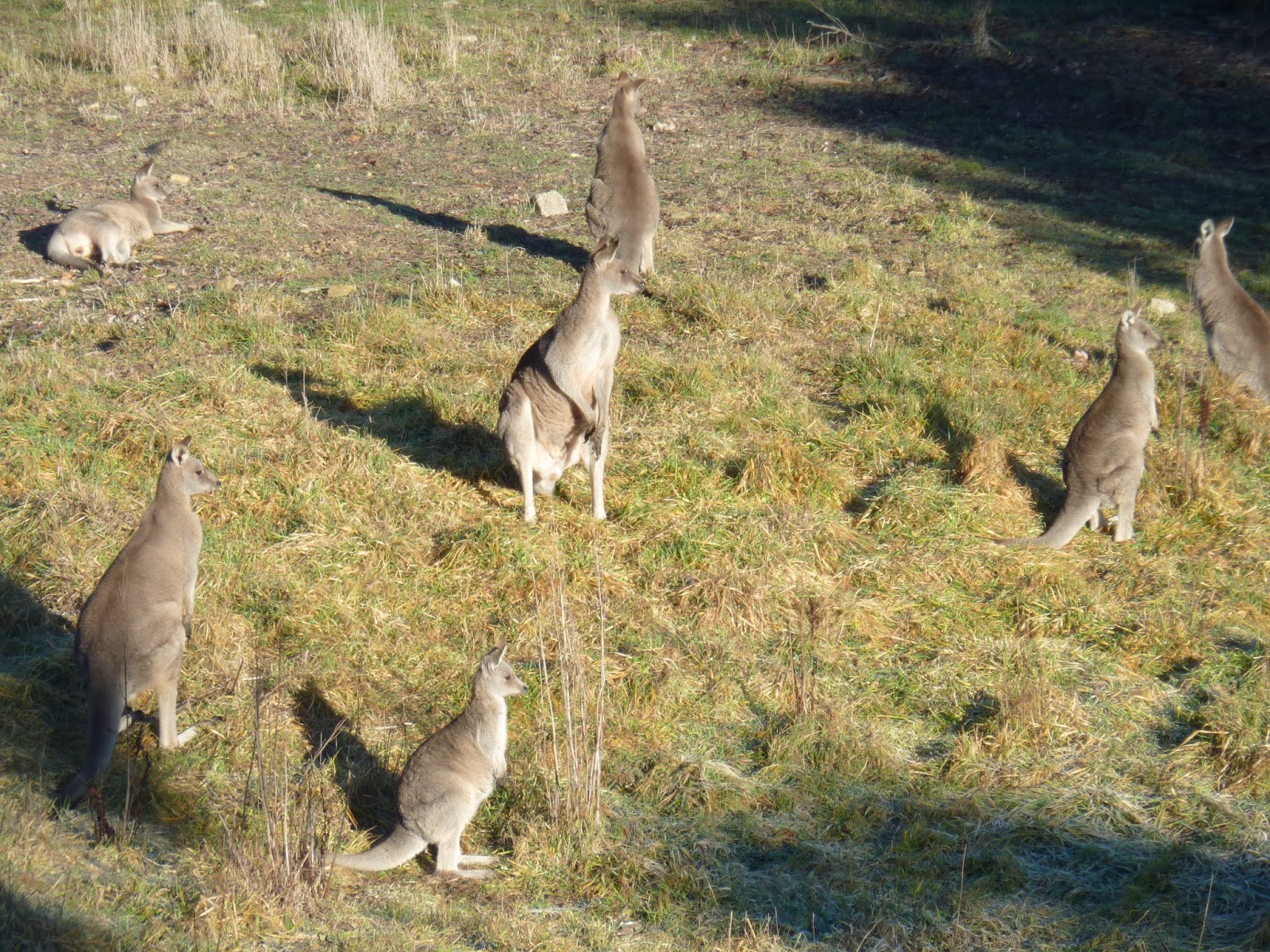
Oh, and here is a picture of a bunch of Canberran kangaroos:

I thought you’d like to know.

In case you were wondering what I’m doing in the Australian winter

I’m here for two very interrelated goals.

I’m having another assessment meeting in September 2014; this time it’s about a possible promotion to associate professor. So Goal #1 is to take a good look again at my research and education vision, and discuss it with whoever I can discuss it with. I got quite some inspiration from the keynotes and discussions at IIFET2014. Not that I went there with a blank slate, but it was good to see my ideas confirmed, in a way, and complemented by other people’s ideas.

I have decided long ago that I will focus on the economics of coastal and marine ecosystems. My background is mainly in bioeconomic modelling, so it is logical to focus my research on the kind of questions that require such modelling. But then the question arises: aren’t many other people doing that already? People have been doing theoretical fisheries economics since the 1950s (or longer, if you consider Jens Warming’s work). And there are gigabytes of applied bioeconomic fisheries models like FishRent and Mefisto, and wholesale ecosystem models like Atlantis, where fishers are included as some sort of predators.

But that’s it, actually: either the models are very abstract and qualitative, so that they can be analysed on paper, or they are very detailed and quantitative, so that they can be used for policy assessment or scenario analysis. The problem with the first is that they lack realism; the problem with the second is that they lack transparency. Either you can explain what drives your results, but then your results are close to useless for policy makers, or you can advise policy makers but you cannot explain where your advice comes from.

What has not yet happened much (I know there are people doing it, but not many), is to take the theoretical models, and make them more realistic to the point where you can maintain some intuition as to what drives your results, even though you cannot prove fancy theorems anymore. Macroeconomists and financial economists have reached that stage long ago: where their models get too complicated to be solved by some math magic, they use computation. This way you can add more realism, while maintaining a fair amount of insight into the mechanisms at work. My intention is to apply such computational methods to problems with coastal and marine ecosystems. This includes a lot of fisheries, but also other ecosystem uses, goods, and services.

Which brings me to Goal #2. The Crawford School of Public Policy of Australian National University has among its staff a number of people who have applied computational economic tools to fisheries problems, like Tom Kompas, Hoang Long Chu, and Quentin Grafton. I’m here to learn at least some of the methods they use. Originally I wanted to stay about two months, but for several reasons I only have about two weeks. But in the short time frame I have I’m trying to get the most out of it.

And lo and behold, I have a first result to show you. My first hurdle was writing a perturbation model in a program I can work with. Their models run in a combination of Matlab and Maple, but I don’t have a license for either of them, and I’m not well-versed in Maple. Hoang Long Chu was so kind to give me a paper by Kenneth Judd and Sy-Ming Guu on writing perturbation models in Mathematica – another program I don’t use, but luckily the paper explains the method well and it presents the entire Mathematica code for a simple optimal growth model. So I decided to write the same method in Python – my language of choice for its elegance, simplicity, and speed (ok, compared with R, which is neither elegant, nor simple, nor speedy). It took me a few days but here it is: the Python code and a pdf with some notes on the paper and the model.

Just a short note

I was going to write a long post about IIFET 2014, and how great a city Brisbane is, and how cold Canberra is. But honestly, now with the MH17 crash, I feel this is just inappropriate. But neither can I not write – I can’t pretend it didn’t happen. So just a short note for those who were wondering where I am.

I flew to Brisbane via Singapore on 4 July 2014 for the IIFET conference. I remember looking at the map (you know how they like to show you where the air plane is) thinking: “whoa, we’re above Ukraine.” I just assumed it was safe – they wouldn’t fly over the place if it weren’t, right? Anyway, I enjoyed Brisbane, gave my presentation, met a lot of friendly and interesting people, had a great dive on Stradbroke Island, flew to Canberra, checked into an Airbnb place, set my iPhone at air plane mode so that I wouldn’t be woken up by any e-mails or text messages in the Australian night, woke up again, switched off air plane mode, and immediately I got a message from a friend asking whether I was safe and sound, what with the plane crash and all.

I think all that must be said has been said in the news media and I have little to add to it. Of course I’m shocked, but anything I can say would just repeat what others have said already. It’s a weird feeling that both my country of origin and the country I’m visiting are in mourning. Flags will be half mast in The Netherlands and Australia tomorrow.

My condolences to the families and friends of the victims.

Burn the schools down

I guess it’s a tradition that every once in a while students revolt against the economics they are being taught. When I was doing my PhD it was a movement calling itself “post-autistic economics”, which was mainly active in France, but also got support elsewhere. I agreed with some of their complaints, although the argumentation was not always that strong and sometimes outright politically motivated (“Capitalism boo! Neo-feminist post-constructionalism yay!”). Later on they changed the name to “Real-World Economics”, perhaps not to offend people suffering from autism. Looking at their review I still don’t get the impression that they’re making much of a dent in the economics debate. Neither am I convinced by what they write, to put it politely.

But now a new revolt has emerged in Manchester. As far as I can see it is more constructive, and more well-argued than the post-autist movement. I agree with some of their points, but not all.

I agree with their proposition that economics teaching should take heed of insights from such fields as psychology, law, and policy science. I don’t know the Manchester program, but I find it curious that such subjects receive as little attention as the Manchester economics students claim. Besides microeconomics, macroeconomics, and econometrics, students in our BSc Economics and Governance program take courses and lectures on history, policy science, institutional economics, and behavioral economics. I guess it’s a question of discussing one particular model or theory very thoroughly, or discussing several different models or theories in a more shallow manner. Our Economics and Governance BSc chooses to be broad, and I agree with that, especially for a problem-oriented university as Wageningen.

I also agree with the Manchester students’ call for a more evidence-based economics, and more attention for the conditions under which different theories and models have more explanatory power than others.

But that’s also where my main objection lies: the call for “pluralism” is translated into more attention to other “schools of thought” than just neoclassical economics. According to the Merriam-Webster Dictionary, a school of thought is

a group sharing a common point of view in respect to some matter (e.g. “she belongs to the liberal school of thought”); also: a point of view recognized as held but not necessarily accepted (e.g. “there are two schools of thought about this question”)

An economist can be “of” a particular school of thought: for example, Paul Krugman is generally considered a Keynesian; Milton Friedman was a monetarist; Herman Daly is an ecological economist; John Kenneth Galbraith was an institutional economist. The natural scientists I work with can only shake their heads when I tell them this. In their fields, there are different theories that compete or need to be reconciled (e.g. general relativity versus quantum mechanics). Or there are different models for different situations, based on simplifying assumptions, and usually developed for a selection of cases but not for all (e.g. metapopulation theory, or the Beverton-Holt stock recruitment model). In that sense, economics is close to ecology: both deal with complex systems that cannot always be experimented on to test competing hypotheses, so we use models that describe a subset of the mechanisms at work. The difference, however, is that whereas even Ilkka Hanski will acknowledge that not all populations can be approached as metapopulations, economists argue as if either Krugman or Friedman is right. On the other hand, schools of thought also have a danger of being politically motivated: if schools of thought are just “points of view”, then you can pick and choose whichever one fits your political preferences. So if you like bow ties, become a Hayekian; if you want to keep your really cool Che Guevara t-shirt, declare yourself a Marxist. (If you’re looking for a steady job in economic policy, follow Keynes.)

In my humble opinion economists must get rid of schools. We should treat our theories like ecologists treat their models: to paraphrase George Box, our models are always wrong in some respect, but they may be useful in some cases. The challenge is to identify the conditions under which they can be useful.

Matteo’s mangrove paper

Go here for the very first peer-reviewed article of our former MSc student, Matteo Zavalloni. The article quantifies the trade-off between two different alternative uses of a mangrove ecosystem and finds that it is crucial to take into account spatial links in this process.

The general idea behind the paper is that a mangrove ecosystem can serve many different purposes, but as space is limited you cannot have them all: in other words, we have a typical economic problem of satisfying wants under limited resources. In his paper Matteo (and I, and Paul van Zwieten) focused on the trade-off between two uses: cultivating shrimp in aquaculture ponds; or providing nursery habitat for juvenile wild shrimp. There is a lot more to mangrove ecosystems than just those two functions: tourists also like to come to mangrove forests (I loved the mangrove forest in Ca Mau, for example), and mangroves also form important coastal protection. In this paper, however, we wanted to explore some methodological issues in a spatially explicit manner, and these two uses were the most appropriate for this analysis.

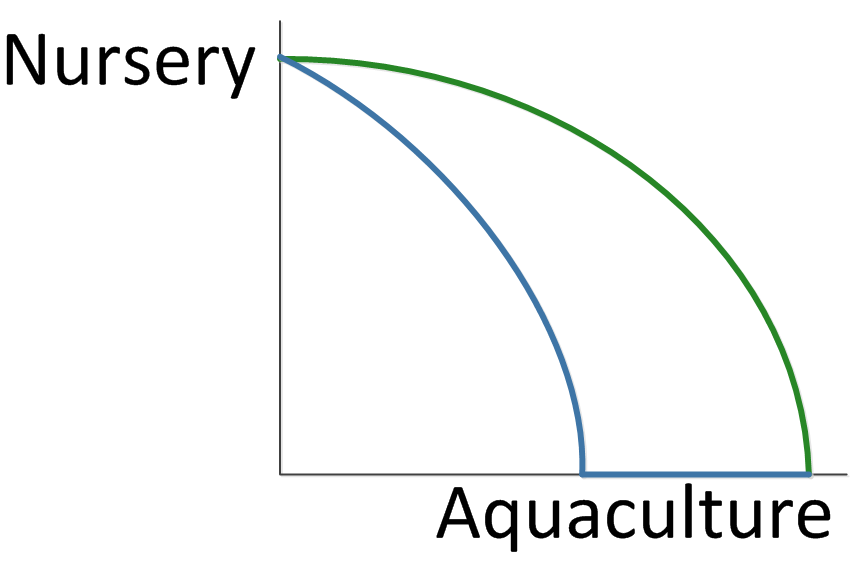
So Matteo developed a model that maximizes the mangrove forest’s nursery function, under the restriction that aquaculture production should not drop below some given level. If you run the model for many different levels of aquaculture production, you typically get a picture like this:

(Be aware that this is not the original picture in the paper but a stylized version of it.)

In economics lingo we call this a production possibilities frontier (PPF). It shows all combinations of two goals (in this case aquaculture production and nursery habitat) that are maximally attainable. Combinations above the curve are impossible to attain; combinations below the curve are feasible, but not very efficient.

Why are there two curves? The green curve indicates the PPF you get if you use all available information on differences in habitat quality, and you take into account that in order to function as a nursery, a mangrove forest must in some way be connected to the water course. The blue curve indicates the PPF if you would ignore (or simply not know) that last piece of information. You see that if you ignore the connectivity you arrive at solutions that provide much less benefits in terms of nursery habitat than what would in theory be possible. The reason is that you locate your shrimp farms at the wrong places:

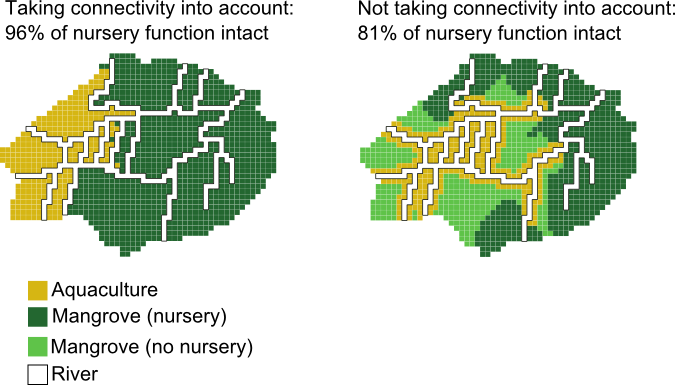
Maximum provision of the nursery ecosystem service at 24% of the possible aquaculture benefits, with and without taking into account the connectivity of nursery habitat

Note that the left picture has all aquaculture clustered together in the west corner of the study area, whereas the right picture has aquaculture located along the water course, blocking the mangrove forest from access to the river. The reason is that farms near the river have lower transport costs, but the consequences for the nursery function are not taken into account.

So how does this help us? First, we wanted to demonstrate that conservation, no matter how noble, has costs, and that those costs should be considered in policy decisions. Second, it illustrates that functions can be combined if you use your information wisely. The approach we developed is one small step towards methods to find the best compromise between different interests in coastal zones.

Random thoughts on freedom

On the day that the Dutch commemorate their liberation from Nazi Germany.

With all the attention going to the Second World War you’d almost forget that this year is also the sad 20-year anniversary of the slaughtering of up to a million Tutsis. I know the Rwandan genocide took place on another continent, whereas the Holocaust happened on our doorstep, so the Dutch could be forgiven for focusing on their own history. Nevertheless, it feels uncomfortable how easy the West seems to forget about one of the most recent, and intense, ethnic cleansings. Every year, when I remember Auschwitz, I also think of Rwanda. And Srebrenica.

Because our commemoration of freedom coincides with the commemoration of the Second World War, the Dutch have a tendency to equate freedom with peace. I consider that too simplistic. If you ask me for my definition of freedom, I would say: the right to deviate. I consider individual rights one of the most important institutions that make us free. Even in a democracy, we need institutions like individual rights to protect us from the government. Without inalienable individual rights, democracy collapses to majoritarianism: two wolves and a sheep voting on lunch. Days like Liberation Day should remind us that although it sometimes feels uneasy or unjust that even the bad guys have individual rights to protect them from the government, the alternative is worse. Just so that next time a criminal gets acquitted because the evidence was acquired through illegal means, we remember what the world would look like if the cops were above the law.

Another reason why I disagree with the “freedom=peace” simplification is that we did not get rid of the Nazis by asking them politely. People were killed. Not just soldiers, but also civilians – my grand parents barely survived the infamous Bezuidenhout Bombing by the Royal Air Force. It’s a painful truth that war – any war – kills not only the bad guys, but also lots and lots of innocent people. Nevertheless, we have forgiven the RAF for its mistake (the Brits were quick to offer their apologies after they realized they bombed civilians, not V2 rockets), and we are still grateful to the British (and the Canadians, the Americans, the Polish, and all other Allied Forces) for liberating us. Had those soldiers not taken the unimaginable risks they took, we would “all be speaking German” as some would have it. Therefore, I believe that veterans – all veterans, not just WW2 veterans – should be an integral part of the Liberation Day events. To thank them, and to honour those who died in service.

That even includes the veterans who fought (and died) in wars we now perhaps think we should not have gotten involved in, like the Indonesian war of independence or the 2003 Iraq war. The Dutch still refer to the Indonesian war of independence as the “Politionele Acties” – a preposterous whitewash of a shameful history if you ask me. The Indonesians deserved to be independent of their colonial masters, and we had no right to govern them. Nevertheless, the soldiers who went were not the people who made the decisions. Only a few had the courage to refuse to go, and their refusal was considered high treason at the time.

Americans treat their veterans with a lot more respect than the Dutch do. When I was in Santa Barbara during Veteran’s Day I read a letter in the local newspaper by a Californian of German-Jewish descent. He explained how American soldiers rescued him, a little kid more dead than alive, from a concentration camp. He stayed with them because he could translate between German and English, and eventually went with them to the USA and became an American citizen. He wrote the letter to express his gratitude to all American veterans, and to the United States in general, for granting him a new lease on life and his freedom. I never forget that story.

Wanted: matching world maps of EEZs and marine productivity

I want to show to my students that only a minority of fish are caught in the high seas, and it would be nice to compare a world map of EEZs to a world map of marine and coastal productivity. So far I’ve found two sources of such information:

For the time being I combined those but the result is not exactly pretty:

(Click on the picture for a closer look.)

The problem is that

  1. The two maps have different centres (Pacific Ocean for GRID-Arendal, Atlantic Ocean for the EEZ map)
  2. The two maps have different projection methods (Gall-Bertin for GRID-Arendal, and I haven’t the faintest idea how to project the EEZ map as such in QGIS)

Are there any maps (preferably shapefiles with the same coordinate systems) of fishing yields and EEZs? Preferably with the Pacific Ocean in the centre? I know the latter is not standard but the Pacific is way more interesting than the Atlantic in this respect.

A simple Python script to make a literature table

Geeky post again – no math this time, but computer code.

I’m sure people have done this before, but I thought it would be a nice opportunity to practice my Python skills to write a small script for the following problem.. Usually when I read a scientific article I watch out for the following elements:

  • Innovation: what does the study do what others haven’t done before?
  • Method: what method did they use?
  • Data: where did they get their data from?
  • Results: what are the main results?
  • Relevance: who benefits from this research, and how?

I also like to place the research in one of the four quadrants in this post. I find it helpful to make an overview of these questions in a table:

1st author Year Journal Quadrant Innovation Method Data Results Relevance
Kompas 2005 Journal of Productivity Analysis 4 Estimates efficiency gains quota trade for Southeast Trawl Fishery, AU Stochastic frontier analysis AFMA and ABARE survey data ITQs gave efficiency gains Policy debate on ITQs
Kompas 2006 Pacific Economic Bulletin 3 Estimates optimal effort levels and allocation across species Multifleet, multispecies, multiregion bioeconomic model SPC data Effort reduction needed; optimal stocks larger than BMSY Policy debate on MEY

But here’s the problem: I usually make my notes in a bibtex file (as a good geek should), which looks like this:

@ARTICLE{Kompas2006PacEconBull,
author = {Kompas, T. and Che, T.N.},
title = {Economic profit and optimal effort in the Western and Central Pacific tuna fisheries},
journal = {Pacific Economic Bulletin},
year = {2006},
volume = {21},
pages = {46-62},
number = {3},
data = {SPC data},
innovation = {Estimates optimal effort levels and allocation across species},
quadrant = {3},
keywords = {tuna; bioeconomic model; optimisation; Pacific},
method = {Multifleet, multispecies, multiregion bioeconomic model},
results = {Effort reduction needed; optimal stocks larger than BMSY},
relevance = {Policy debate on MEY}
}

@ARTICLE{Kompas2005JProdAnalysis,
author = {Kompas, Tom and Che, Tuong Nhu},
title = {Efficiency gains and cost reductions from individual transferable quotas: A stochastic cost frontier for the Australian South East fishery},
journal = {Journal of Productivity Analysis},
year = {2005},
volume = {23},
pages = {285-307},
number = {3},
quadrant = {3},
data = {AFMA and ABARE survey data},
innovation = {Estimates efficiency gains quota trade for Southeast Trawl Fishery, AU},
keywords = {individual transferable quotas; stochastic cost frontier; fishery efficiency; ITQs},
method = {Stochastic frontier analysis},
relevance = {Policy debate on ITQs.},
results = {ITQs gave efficiency gains}
}

I don’t want to copy it all by hand, so I wrote this little script in Python to convert all entries in the bibtex file to a csv file:

import csv
from bibtexparser.bparser import BibTexParser
from dicttoxml import dicttoxml
from operator import itemgetter

def readFirstAuthor(inpList,num):
author1 = ""
x = inpList[num]['author']
for j in x:
if j != ',':
author1+=j
else:
break
return author1

def selectDict(inpList,name):
outObj = []
for i in range(len(inpList)):
if name in inpList[i]['author'] and \
            inpList[i]['type']=='article':
outObj.append(inpList[i])
return(outObj)

def selectFieldsDict(inpList,fieldNames):
outObj = []
for i in range(len(inpList)):
temp = {}
for n in fieldNames:
if n == 'author':
author1 = readFirstAuthor(inpList,i)
temp['author'] = author1
else:
if n in inpList[i]:
temp[n] = inpList[i][n]
else:
temp[n] = 'blank'
outObj.append(temp)
return(outObj)

fieldnames = ['author','year','journal','quadrant',\
    'innovation','method','data','results','relevance']

with open('BibTexFile.bib', 'r') as bibfile:
bp = BibTexParser(bibfile)

record_list = bp.get_entry_list()
record_dict = bp.get_entry_dict()

dictSelection = selectDict(record_list,'Kompas')

fieldSelection = selectFieldsDict(dictSelection,fieldnames)


test = sorted(fieldSelection, key=itemgetter('year'))


test_file = open('output.csv','wb')
csvwriter = csv.DictWriter(test_file, delimiter=',',\
    fieldnames=fieldnames)
csvwriter.writerow(dict((fn,fn) for fn in fieldnames))
for row in test:
csvwriter.writerow(row)
test_file.close()

If you are a Python developer: any comments on this are welcome. I’m sure it’s not perfect.

My thoughts on Daniel Bromley’s critique (3): Are ITQs private property rights?

In my first post in this series I argued that although open access is just about the worst property rights regime to have in a fishery, it is too simple to blame all overfishing on ‘lack of property rights’; rather, we need to go into the details of the institutional setting. In my second post I argued that asking whether private property rights can manage a fishery is a waste of time: marine ecosystems are too complicated to implement any real form of private property.

But wait a minute. Aren’t ITQs supposed to be private property? You can find many articles in the scientific literature and the press, whether they’re in favour of ITQs or against them, that present ITQs as private property. Daniel Bromley does not agree. In his Fisheries article he lists as one of the deceits of fisheries economics its claim that “ITQs are private property rights.” His objection to this idea is that the Magnuson-Stevens act (which is by far the most important fisheries law in the United States) states that ITQs are permits, which can be revoked, limited, or changed by the government without compensation to the owner of the permit.

The reply of some economists is that in practice, even American ITQs are traded between fishers, they are used as collateral for loans, and they are subject to legal disputes over divorce and inheritance, just like houses or cars are. So de jure they might not be private property rights, de facto they certainly are.

In any case, I’m a European, and in Europe we could decide to make ITQs irrevocable rights that have an unlimited life span, and cannot be changed by the government (unless in cases of eminent domain). Would they then be private property rights?

If I were a German I would say: jein. The certificate would be private property: the law can be made such that you can freely trade the certificate, the government cannot take it from you without compensation, you can use it as collatoral, and if you die your kids might fight over it in court. But that’s the certificate – not the fish. As I argued in an earlier post: owning an ITQ does not mean that there’s a fish with your name on it.

As far as I know the closest equivalent of ITQs (assuming the most extreme case of privatization) would be shares in a corporation (or LLC, PLC, SA, BV, NV, whichever country you happen to live in – I’m no legal expert). In the fishery, the ‘company’ would be the fish stock; the ‘dividend’ would be the TAC; the ‘shareholders’ would be the fishers, who, unlike regular shareholders, are supposed to come and catch their ‘dividend’ for themselves. I’m no more a business economist than I am a legal expert, so I don’t know whether I should consider a corporation private property or common property. If I strictly follow Bromley’s terminology I’d guess they are common property, because it is the shareholders who commonly own the asset and have influence – albeit sometimes limited – on the company’s management. But I’m glad I’m writing this on a blog and not in a peer-reviewed article (that’s what blogs are for, aren’t they?).

There are some interesting differences between ITQs and corporate shares, but I’ll save that for later.