Scenario issues: scenarios versus policies

I usually emphasize in my lectures that you should strictly distinguish policies from scenarios. Policies are what we choose; scenarios simply describe what might happen, regardless of what we choose. In practice it is not as clear-cut as that may seem.

Look at it like this. Suppose we have two policy options. To choose the right policy we also need to know how each policy plays out in the future. But there we have a problem: we don’t know what the future will look like. Usually, however, we do have a rough idea of developments that may take place. We could take some of those developments and explore how they might combine. By doing this we develop a number of scenarios that illustrate what the future could look like (not what it will look like). We can then evaluate our policy options in each scenario. For example, with two policy options and two scenarios we could make a table like this:

Scenario 1 Scenario 2
Policy 1 You win $100 You lose $100
Policy 2 You lose $50 You win $80

In any environmental economics textbook you will find different possible rules to choose between policy options under such uncertainty. Perhaps you want to minimize the possible losses from your policy. By such a maximin rule, as it is called, you would ignore the best outcomes and focus on the worst ones. So you choose Policy 2 because the worst that could happen under Policy 2 is that you lose $50 where under Policy 1 you could lose $100. It is also possible that you want to get as much as possible out of your policy. By following a maximax rule, where you ignore the worst outcomes and focus on the best ones, you would go for Policy 1. After all, Policy 1 could yield $100 where Policy 2 can, at best, yield only $80. And there are more decision rules.

Every year I see students, when asked exam questions like the problem above, give answers like “I would choose Scenario 1”. Which is why I keep emphasizing: you don’t choose scenarios. Nature chooses the scenario. Or God, or Fate, whatever you want to call it. But not the policy maker.

But now comes the tricky part. Suppose the policy maker cannot choose all possible policies at once. Perhaps she works at some government department that decides on some policies, but there are other policies that are decided by other departments. Or the effect of her policies depend on what other governments do.

We’re having discussions about this all the time in VECTORS. For example, an Environment Ministry might want to evaluate a ballast water treatment policy to combat invasive species, but the effects of the policy also depend on international trade policies which are decided by the Ministry of Economic Affairs, or even other countries’ policies. The trade policy might then become part of the scenarios as far as the Environment Ministry is concerned. This is very confusing, and I notice that a lot of people are uncomfortable with including policies as part of scenarios. It seems to me that they prefer their scenarios as pure, roll-the-dice, chance events. Their objection to including policies in scenarios is that, eventually, people decide on policies. They are not chance events. My reply would be that we can only decide on a particular domain, like ballast water treatment policy, or fisheries policy, or MPA allocation. What happens outside that domain is something we cannot influence, so it has to be considered a chance event. But I agree it feels uncomfortable, and the line is difficult to draw.
Crystal ball gazing, the academic way

The excitement of international science workshops

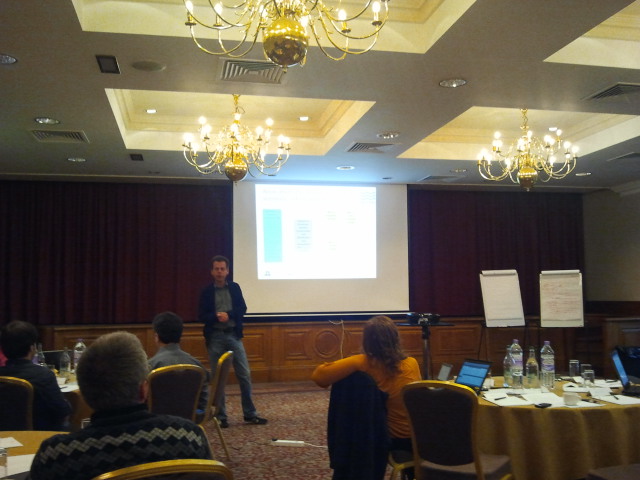
So I’m in this international research project VECTORS, dealing with many exciting and fascinating issues, working with scientists from all over Europe. But if I tell you I was at a VECTORS workshop in Edinburgh last week, it’s not exactly like we were sipping 40 year old Talisker in Edinburgh Castle with Queen Elisabeth. A business hotel near the airport is more like it: easier to reach, lots of meeting rooms, good food, and no distractions.

Scenarios were the main theme this time. A lot of the developments that VECTORS deals with are highly uncertain. How warm (or cold) will our waters be in the coming 50 years? How many sunbathers will visit Mediterranean beaches? How many international transport vessels will visit the ports of Rotterdam and Antwerp?

You may be tempted to address these questions through some sort of sensitivity analysis: do your calculations for different values of the uncertain variables, or rather, combinations of different values. If you know the probability of some outcome of some variable (say, “the probability that temperatures increase by 1 degree or more is 30%”) you could estimate the probability of some outcome of your models’ output (“the probability that average income increases by €100 per month or more is 50%”). But you will run into a number of problems:

  • You don’t know probabilities.
  • Even if you knew the probabilities they would not be independent. A high nutrient load is more likely if there are many people around spending their money on lots of meat or highly fertilised crops than if the population is small and poor.
  • The number of possible combinations grows exponentially with the number of variables. Suppose you want to consider three levels of each variable. Then one variable gives you three possible outcomes; two variables have nine possible outcomes; three variables have 27 possible outcomes; 10 variables have 59,049 possible outcomes. And then the ecologists in your team tell you that running one such outcome on their model takes one month. So if you have 5000 years you can do a sensitivity analysis of all 10 variables!
  • There are many other possible developments that are difficult to capture in numbers, such as changes in regulations, customs, technologies, and so on.
  • Policy makers have neither the time nor the energy to read your entire sensitivity analysis. They want something you can summarise in one page (which they skim rather than read).

So what do we do? We develop scenarios. But what are scenarios?

A scenario is not a prediction of the future. It is more like a story line that describes how the world might develop in the future, taking into account different possible trends. It should be consistent, and ideally you have a set of scenarios that spans a fairly wide range of possible developments.

A scenario is not a policy option. When you see the different scenarios from, say, the IPCC, you may be tempted to say: “let’s go for this one.” But although you may certainly like some outlooks more than others, the idea is that you don’t know which one will come true – and you have no influence on which one comes true.

At least, scenarios can help us to make sense of the complexity of the different social, economic, political, and biophysical changes that may take place in the future. A few consistent story lines are easier to understand than countless histograms and plots, for scientists as well as policy makers. And they still allow us to explore how different policy choices may work out in the future.

At some point I joked that we should have Philip Pullman write our scenarios, but I was only half joking. It’s at least as much an art as it is a science.