Judd and Guu’s stochastic perturbation model in Python

I just uploaded a Python version of Judd and Guu’s perturbation code to my website (code; notes).

If you happen to be a Python programmer, or a computational economist (even better: both!), then any feedback you can give on the code is highly appreciated. I’m fairly new to Python, so I’m sure I could have programmed some parts more efficiently.

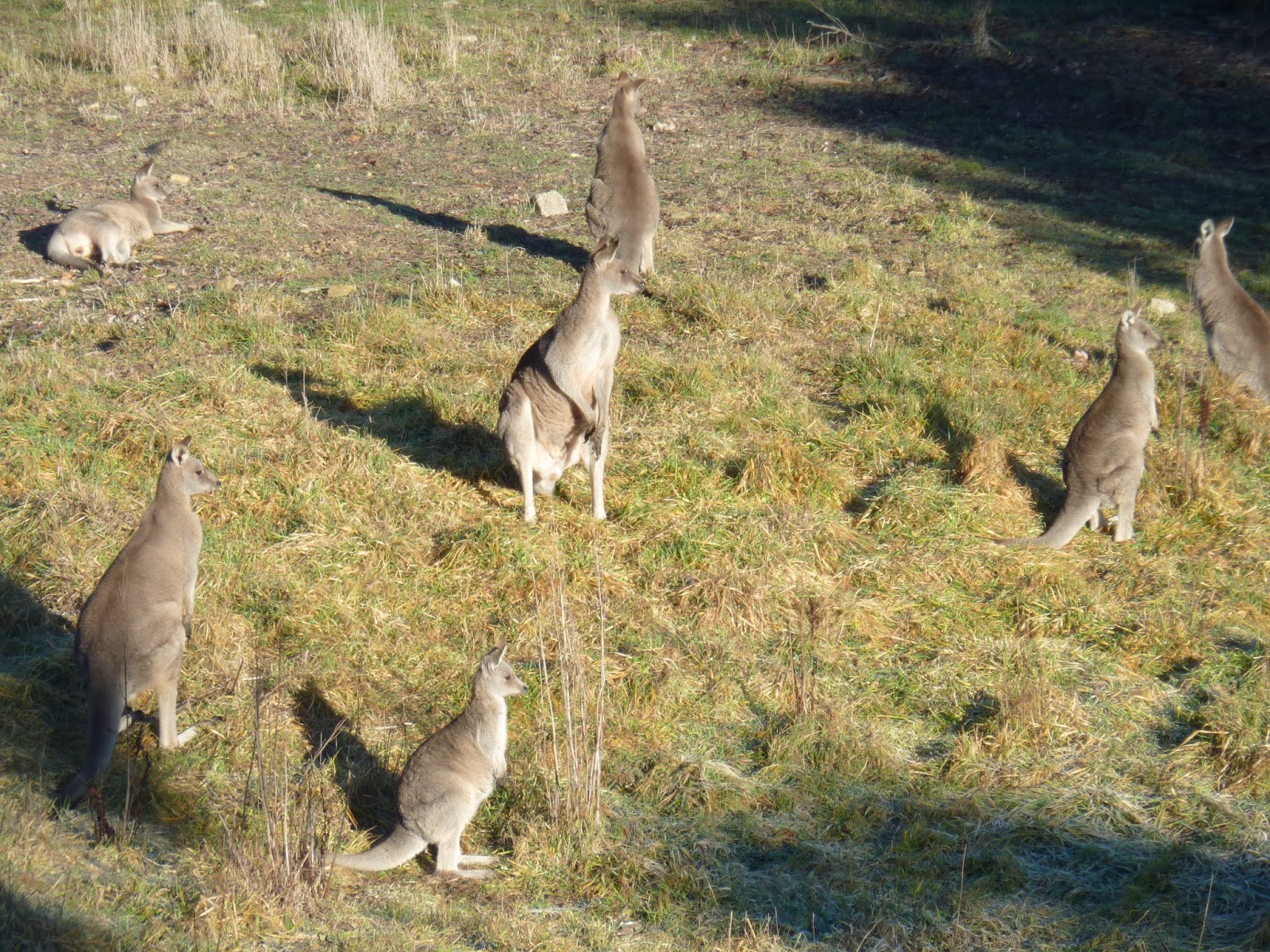
Oh, and here is a picture of a bunch of Canberran kangaroos:

I thought you’d like to know.

In case you were wondering what I’m doing in the Australian winter

I’m here for two very interrelated goals.

I’m having another assessment meeting in September 2014; this time it’s about a possible promotion to associate professor. So Goal #1 is to take a good look again at my research and education vision, and discuss it with whoever I can discuss it with. I got quite some inspiration from the keynotes and discussions at IIFET2014. Not that I went there with a blank slate, but it was good to see my ideas confirmed, in a way, and complemented by other people’s ideas.

I have decided long ago that I will focus on the economics of coastal and marine ecosystems. My background is mainly in bioeconomic modelling, so it is logical to focus my research on the kind of questions that require such modelling. But then the question arises: aren’t many other people doing that already? People have been doing theoretical fisheries economics since the 1950s (or longer, if you consider Jens Warming’s work). And there are gigabytes of applied bioeconomic fisheries models like FishRent and Mefisto, and wholesale ecosystem models like Atlantis, where fishers are included as some sort of predators.

But that’s it, actually: either the models are very abstract and qualitative, so that they can be analysed on paper, or they are very detailed and quantitative, so that they can be used for policy assessment or scenario analysis. The problem with the first is that they lack realism; the problem with the second is that they lack transparency. Either you can explain what drives your results, but then your results are close to useless for policy makers, or you can advise policy makers but you cannot explain where your advice comes from.

What has not yet happened much (I know there are people doing it, but not many), is to take the theoretical models, and make them more realistic to the point where you can maintain some intuition as to what drives your results, even though you cannot prove fancy theorems anymore. Macroeconomists and financial economists have reached that stage long ago: where their models get too complicated to be solved by some math magic, they use computation. This way you can add more realism, while maintaining a fair amount of insight into the mechanisms at work. My intention is to apply such computational methods to problems with coastal and marine ecosystems. This includes a lot of fisheries, but also other ecosystem uses, goods, and services.

Which brings me to Goal #2. The Crawford School of Public Policy of Australian National University has among its staff a number of people who have applied computational economic tools to fisheries problems, like Tom Kompas, Hoang Long Chu, and Quentin Grafton. I’m here to learn at least some of the methods they use. Originally I wanted to stay about two months, but for several reasons I only have about two weeks. But in the short time frame I have I’m trying to get the most out of it.

And lo and behold, I have a first result to show you. My first hurdle was writing a perturbation model in a program I can work with. Their models run in a combination of Matlab and Maple, but I don’t have a license for either of them, and I’m not well-versed in Maple. Hoang Long Chu was so kind to give me a paper by Kenneth Judd and Sy-Ming Guu on writing perturbation models in Mathematica – another program I don’t use, but luckily the paper explains the method well and it presents the entire Mathematica code for a simple optimal growth model. So I decided to write the same method in Python – my language of choice for its elegance, simplicity, and speed (ok, compared with R, which is neither elegant, nor simple, nor speedy). It took me a few days but here it is: the Python code and a pdf with some notes on the paper and the model.

Just a short note

I was going to write a long post about IIFET 2014, and how great a city Brisbane is, and how cold Canberra is. But honestly, now with the MH17 crash, I feel this is just inappropriate. But neither can I not write – I can’t pretend it didn’t happen. So just a short note for those who were wondering where I am.

I flew to Brisbane via Singapore on 4 July 2014 for the IIFET conference. I remember looking at the map (you know how they like to show you where the air plane is) thinking: “whoa, we’re above Ukraine.” I just assumed it was safe – they wouldn’t fly over the place if it weren’t, right? Anyway, I enjoyed Brisbane, gave my presentation, met a lot of friendly and interesting people, had a great dive on Stradbroke Island, flew to Canberra, checked into an Airbnb place, set my iPhone at air plane mode so that I wouldn’t be woken up by any e-mails or text messages in the Australian night, woke up again, switched off air plane mode, and immediately I got a message from a friend asking whether I was safe and sound, what with the plane crash and all.

I think all that must be said has been said in the news media and I have little to add to it. Of course I’m shocked, but anything I can say would just repeat what others have said already. It’s a weird feeling that both my country of origin and the country I’m visiting are in mourning. Flags will be half mast in The Netherlands and Australia tomorrow.

My condolences to the families and friends of the victims.

Burn the schools down

I guess it’s a tradition that every once in a while students revolt against the economics they are being taught. When I was doing my PhD it was a movement calling itself “post-autistic economics”, which was mainly active in France, but also got support elsewhere. I agreed with some of their complaints, although the argumentation was not always that strong and sometimes outright politically motivated (“Capitalism boo! Neo-feminist post-constructionalism yay!”). Later on they changed the name to “Real-World Economics”, perhaps not to offend people suffering from autism. Looking at their review I still don’t get the impression that they’re making much of a dent in the economics debate. Neither am I convinced by what they write, to put it politely.

But now a new revolt has emerged in Manchester. As far as I can see it is more constructive, and more well-argued than the post-autist movement. I agree with some of their points, but not all.

I agree with their proposition that economics teaching should take heed of insights from such fields as psychology, law, and policy science. I don’t know the Manchester program, but I find it curious that such subjects receive as little attention as the Manchester economics students claim. Besides microeconomics, macroeconomics, and econometrics, students in our BSc Economics and Governance program take courses and lectures on history, policy science, institutional economics, and behavioral economics. I guess it’s a question of discussing one particular model or theory very thoroughly, or discussing several different models or theories in a more shallow manner. Our Economics and Governance BSc chooses to be broad, and I agree with that, especially for a problem-oriented university as Wageningen.

I also agree with the Manchester students’ call for a more evidence-based economics, and more attention for the conditions under which different theories and models have more explanatory power than others.

But that’s also where my main objection lies: the call for “pluralism” is translated into more attention to other “schools of thought” than just neoclassical economics. According to the Merriam-Webster Dictionary, a school of thought is

a group sharing a common point of view in respect to some matter (e.g. “she belongs to the liberal school of thought”); also: a point of view recognized as held but not necessarily accepted (e.g. “there are two schools of thought about this question”)

An economist can be “of” a particular school of thought: for example, Paul Krugman is generally considered a Keynesian; Milton Friedman was a monetarist; Herman Daly is an ecological economist; John Kenneth Galbraith was an institutional economist. The natural scientists I work with can only shake their heads when I tell them this. In their fields, there are different theories that compete or need to be reconciled (e.g. general relativity versus quantum mechanics). Or there are different models for different situations, based on simplifying assumptions, and usually developed for a selection of cases but not for all (e.g. metapopulation theory, or the Beverton-Holt stock recruitment model). In that sense, economics is close to ecology: both deal with complex systems that cannot always be experimented on to test competing hypotheses, so we use models that describe a subset of the mechanisms at work. The difference, however, is that whereas even Ilkka Hanski will acknowledge that not all populations can be approached as metapopulations, economists argue as if either Krugman or Friedman is right. On the other hand, schools of thought also have a danger of being politically motivated: if schools of thought are just “points of view”, then you can pick and choose whichever one fits your political preferences. So if you like bow ties, become a Hayekian; if you want to keep your really cool Che Guevara t-shirt, declare yourself a Marxist. (If you’re looking for a steady job in economic policy, follow Keynes.)

In my humble opinion economists must get rid of schools. We should treat our theories like ecologists treat their models: to paraphrase George Box, our models are always wrong in some respect, but they may be useful in some cases. The challenge is to identify the conditions under which they can be useful.

Matteo’s mangrove paper

Go here for the very first peer-reviewed article of our former MSc student, Matteo Zavalloni. The article quantifies the trade-off between two different alternative uses of a mangrove ecosystem and finds that it is crucial to take into account spatial links in this process.

The general idea behind the paper is that a mangrove ecosystem can serve many different purposes, but as space is limited you cannot have them all: in other words, we have a typical economic problem of satisfying wants under limited resources. In his paper Matteo (and I, and Paul van Zwieten) focused on the trade-off between two uses: cultivating shrimp in aquaculture ponds; or providing nursery habitat for juvenile wild shrimp. There is a lot more to mangrove ecosystems than just those two functions: tourists also like to come to mangrove forests (I loved the mangrove forest in Ca Mau, for example), and mangroves also form important coastal protection. In this paper, however, we wanted to explore some methodological issues in a spatially explicit manner, and these two uses were the most appropriate for this analysis.

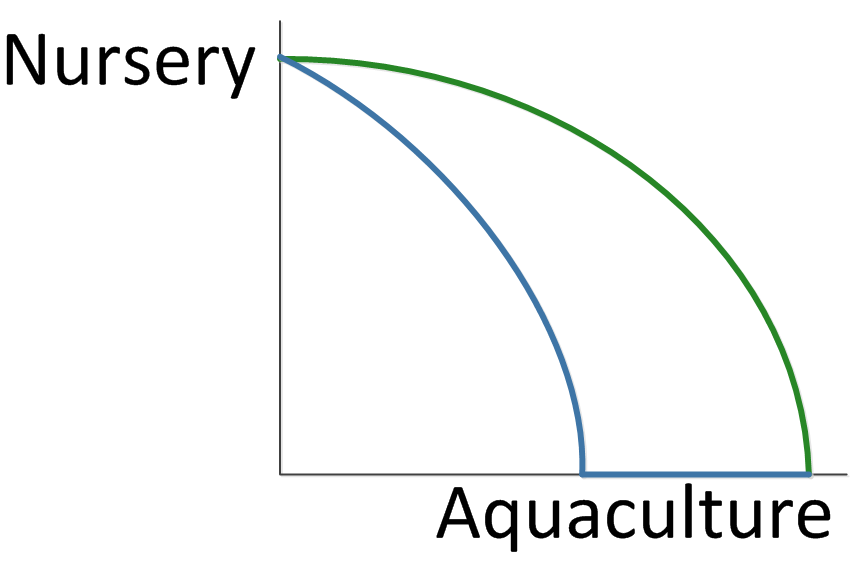
So Matteo developed a model that maximizes the mangrove forest’s nursery function, under the restriction that aquaculture production should not drop below some given level. If you run the model for many different levels of aquaculture production, you typically get a picture like this:

(Be aware that this is not the original picture in the paper but a stylized version of it.)

In economics lingo we call this a production possibilities frontier (PPF). It shows all combinations of two goals (in this case aquaculture production and nursery habitat) that are maximally attainable. Combinations above the curve are impossible to attain; combinations below the curve are feasible, but not very efficient.

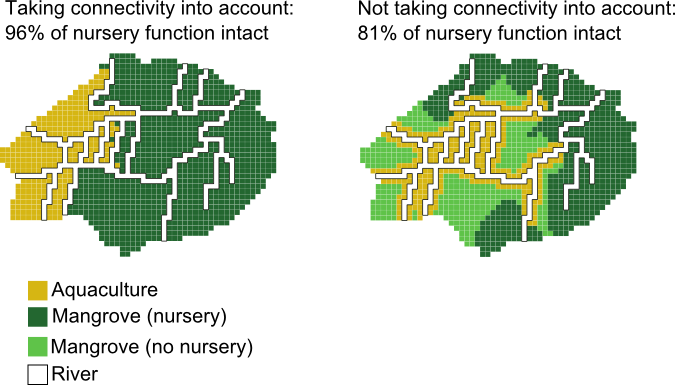
Why are there two curves? The green curve indicates the PPF you get if you use all available information on differences in habitat quality, and you take into account that in order to function as a nursery, a mangrove forest must in some way be connected to the water course. The blue curve indicates the PPF if you would ignore (or simply not know) that last piece of information. You see that if you ignore the connectivity you arrive at solutions that provide much less benefits in terms of nursery habitat than what would in theory be possible. The reason is that you locate your shrimp farms at the wrong places:

Maximum provision of the nursery ecosystem service at 24% of the possible aquaculture benefits, with and without taking into account the connectivity of nursery habitat

Note that the left picture has all aquaculture clustered together in the west corner of the study area, whereas the right picture has aquaculture located along the water course, blocking the mangrove forest from access to the river. The reason is that farms near the river have lower transport costs, but the consequences for the nursery function are not taken into account.

So how does this help us? First, we wanted to demonstrate that conservation, no matter how noble, has costs, and that those costs should be considered in policy decisions. Second, it illustrates that functions can be combined if you use your information wisely. The approach we developed is one small step towards methods to find the best compromise between different interests in coastal zones.

Random thoughts on freedom

On the day that the Dutch commemorate their liberation from Nazi Germany.

With all the attention going to the Second World War you’d almost forget that this year is also the sad 20-year anniversary of the slaughtering of up to a million Tutsis. I know the Rwandan genocide took place on another continent, whereas the Holocaust happened on our doorstep, so the Dutch could be forgiven for focusing on their own history. Nevertheless, it feels uncomfortable how easy the West seems to forget about one of the most recent, and intense, ethnic cleansings. Every year, when I remember Auschwitz, I also think of Rwanda. And Srebrenica.

Because our commemoration of freedom coincides with the commemoration of the Second World War, the Dutch have a tendency to equate freedom with peace. I consider that too simplistic. If you ask me for my definition of freedom, I would say: the right to deviate. I consider individual rights one of the most important institutions that make us free. Even in a democracy, we need institutions like individual rights to protect us from the government. Without inalienable individual rights, democracy collapses to majoritarianism: two wolves and a sheep voting on lunch. Days like Liberation Day should remind us that although it sometimes feels uneasy or unjust that even the bad guys have individual rights to protect them from the government, the alternative is worse. Just so that next time a criminal gets acquitted because the evidence was acquired through illegal means, we remember what the world would look like if the cops were above the law.

Another reason why I disagree with the “freedom=peace” simplification is that we did not get rid of the Nazis by asking them politely. People were killed. Not just soldiers, but also civilians – my grand parents barely survived the infamous Bezuidenhout Bombing by the Royal Air Force. It’s a painful truth that war – any war – kills not only the bad guys, but also lots and lots of innocent people. Nevertheless, we have forgiven the RAF for its mistake (the Brits were quick to offer their apologies after they realized they bombed civilians, not V2 rockets), and we are still grateful to the British (and the Canadians, the Americans, the Polish, and all other Allied Forces) for liberating us. Had those soldiers not taken the unimaginable risks they took, we would “all be speaking German” as some would have it. Therefore, I believe that veterans – all veterans, not just WW2 veterans – should be an integral part of the Liberation Day events. To thank them, and to honour those who died in service.

That even includes the veterans who fought (and died) in wars we now perhaps think we should not have gotten involved in, like the Indonesian war of independence or the 2003 Iraq war. The Dutch still refer to the Indonesian war of independence as the “Politionele Acties” – a preposterous whitewash of a shameful history if you ask me. The Indonesians deserved to be independent of their colonial masters, and we had no right to govern them. Nevertheless, the soldiers who went were not the people who made the decisions. Only a few had the courage to refuse to go, and their refusal was considered high treason at the time.

Americans treat their veterans with a lot more respect than the Dutch do. When I was in Santa Barbara during Veteran’s Day I read a letter in the local newspaper by a Californian of German-Jewish descent. He explained how American soldiers rescued him, a little kid more dead than alive, from a concentration camp. He stayed with them because he could translate between German and English, and eventually went with them to the USA and became an American citizen. He wrote the letter to express his gratitude to all American veterans, and to the United States in general, for granting him a new lease on life and his freedom. I never forget that story.

Matilda, three songs, and the melancholy of travelling

‘Tis the season again. In The Netherlands this means that a bunch of radio jocks have a public fasting exercise to collect donations for the Red Cross. Serious Request it’s called, and, guess what, the main thing is to make your donation together with your request for your favourite song. I’m not too much of a listener to 3FM (their radio station), but it’s becoming a bit of a tradition for me to request Tom Waits’s Tom Traubert’s Blues every year:

Waits wrote the song in the 1970s, when his music was usually a bourbon-soaked mix of jazz and blues, with a Sinatraesque ballad thrown in here and there, and as major themes booze, gambling, and bad women. Everything changed, however, when he met Kathleen Brennan. She got him to give up drinking, introduced him to the music of Captain Beefheart, and thereby induced his major shift to the almost absurdistic albums he made from that point on, like Swordfishtrombones, Raindogs, and Bone Machine. I must admit I usually prefer the post-Brennan crazy stuff. His 1970s ballads could verge dangerously on the sentimental and the cliche-ridden; meanwhile, nothing beats the spooky weirdness of What’s he building in there?, or the brutal stomp of Singapore.

Except, that is, for this one song. The lyrics conjure up strong images, yet are sufficiently abstract to give the song an enigmatic quality – and to provoke lots of debate on what the song is about. Some think it is about addiction, or even suicide. Tom Waits himself usually introduces the song by saying “this song is about throwing up in a foreign country.” Supposedly he wrote the song after a drinking binge in Copenhagen with Danish singer and violinist Mathilde Bondo (hence the subtitle “Four sheets to the wind in Copenhagen”). Another story is that he wrote the song after hanging out with LA’s down-and-out (“every single guy…a woman put him there” he is reported to have said).

I used to think the song was about the First World War – seriously. When I started listening to Tom Waits I had been playing Irish music for a few years. The standard repertoire includes The Band Played Waltzing Matilda by the Scottish-Australian songwriter Eric Bogle:

That song is about WW1, telling the story of one of the many Australian soldiers caught up in the murderous meat grinding machine of Gallipoli, in what was in those days the Ottoman Empire. The title of Bogle’s song (and the chorus in Waits’) refers to Waltzing Matilda, an Australian folksong about a transient worker that was (and still is) Australia’s unofficial national anthem. Apparently, ‘To waltz Matilda’ is Australian slang for travelling by foot with your belongings stuffed in a rucksack. Bogle’s song describes how Waltzing Matilda accompanied the soldiers’ march to and from the battlefield, their remembrance marches, and perhaps even their afterlife:

And their ghosts may be heard as you pass by a billabong
Who’ll come a-waltzing Matilda with me?

So when I heard Waits sing:

I’m an innocent victim of a blinded alley
And I’m tired of all these soldiers here
No-one speaks English and everything’s broken
And my stacys are soaking wet

I couldn’t help but imagine a lonely American, lost somewhere in a faraway corner of the crumbling Ottoman Empire (say, present-day Egypt, or Jordania), with nothing but his once fancy, but now torn and dirty clothes and shoes. And what about these lines?

You can ask any sailor and the keys from the jailer
And the old men in wheelchairs know
Matilda’s the defendant, she killed about a hundred
And she follows wherever you may go

I figured the old men in wheelchairs could very well be the veterans in Bogle’s song:

And now every April I sit on my porch
And I watch the parade pass before me
I see my old comrades, how proudly they march
Renewing their dreams of past glory
I see the old men, bent, stiff, and sore
These tired old heroes of a forgotten war
And young people ask: what are they marching for?
And I ask myself the same question

Bogle wrote his song in 1971, so it is possible – but I’m quite sure it is a coincidence and Waits did not have The Great War in mind when he wrote Tom Traubert’s Blues.

Not that I care much for whether he did. To me, this image of a forlorn Westerner, lost in a country where he does not speak the language while the world is crumbling all around him, fits the lyrics perfectly. The song has a loneliness and a lostness to it that Waits must have recognized in the LA skid row (or in the Copenhagen porcelain truck after his drinking binge with Mathilde). I usually play the song on my mp3 player when I’m abroad for work. When you are in the bus from the center of Reykjavik to your hotel in a depressing office quarter at the border of town, nothing fits your mood better than hearing this grinding voice wail

It’s a battered old suitcase
To a hotel some place
And a wound that will never heal

Just writing it gives me goosebumps: a wound that will never heal. When we travel, we leave behind the places and people we know and love. But we also develop a fondness for the place we’ve travelled to, which only gets stronger as we stay there longer. What I’d give for just one more bike ride along the coast of Santa Barbara, or a Guinness in Gogarty’s, Dublin, or a fried fish and a vinho verde in some small unassuming restaurant on the Azores… Wherever you go, even if you go home, part of you still wishes you were back somewhere else.
Confusing Nemo (1): How much is too much?

The Black Fish, an environmental NGO, has made an animation movie on fisheries. Laudibly, the organisation provides the sources for its (albeit not all) claims. I agree with some statements they make, but not all. Let me go through some of them one by one in a series of posts. Number one:

“The global fishing fleet hauls in 80 million tonnes of sea food”

The latest FAO report on the State of the World’s Fisheries and Aquaculture (SOFIA) on this states that the amount of fish captured in marine areas is indeed around 80 million tonnes each year. I suspect, however, that this only includes the recorded landings: figures on discards and illegal landings are probably too shaky to be included in these figures. So catches might actually be higher.

So the 80 million tonnes seems accurate, but is it much? For comparison: FAOSTAT states that the world produced almost 300 million tonnes of meat in 2011. But that says little about whether 80 million tonnes (or perhaps more, due to discards and illegal landings) is too much. The most widely used benchmark for this is maximum sustainable yield (MSY). The SOFIA does that, and concludes that around half of evaluated stocks is fully exploited (around MSY); overexploited stocks (stocks that, in the report’s definition, “produce lower yields than their biological and ecological potential”, due to low stock abundance) make up about 30% of the stocks evaluated. Of the remaining 20% harvests can be increased sustainably. What the report also says is that

The declining global catch over the last few years together with the increased percentage of overexploited fish stocks and the decreased proportion of non-fully exploited species around the world convey a strong message – the state of world marine fisheries is worsening and has had a negative impact on fishery production.

In other words, the fact that slowly the number of overexploited stocks is increasing while catches stabilize or decline should, according to the FAO, be taken as a bad sign.

If you want a second opinion, this article by Boris Worm and others should be a good place to start. The authors examined the exploitation rate and biomass of 166 stocks worldwide and found, among others, that

For about two-thirds of the examined stocks (63%), biomass (B) has dropped below the traditional single-species management target of MSY, that is, B < BMSY. About half of those stocks (28% of total) have exploitation rates that would allow for rebuilding to BMSY, that is, u < uMSY, whereas overfishing continues in the remainder (u > uMSY in 35% of all stocks).

That’s the bad news. Interestingly, the article also states that

Since the 1990s, Iceland, Newfoundland-Labrador, the Northeast U.S. Shelf, the Southeast Australian Shelf, and California Current ecosystems have shown substantial declines in fishing pressure such that they are now at or below the modeled uMMSY. However, only in the California Current and in New Zealand are current exploitation rates predicted to achieve a conservation target of less than 10% of stocks collapsed.

So is the 80 million cited in Losing Nemo accurate? It seems so. Is 80 million too much? For the short run it also seems so, but on the long term it is more difficult to say. As Worm et al. state, it is still possible to rebuild stocks, and we can only do so by catching less. So far I haven’t found any figures on how productive world fisheries stocks could be if we managed them well: 70 million tons? 90 million tons? In any case, things are moving in the right direction as the exploitation rate is slowly declining in most, albeit not all fishing grounds.

Damn you, lack of global warming

The lack of Spring is taking its toll. We’ll have to wait another two weeks for our fresh maatjes:

The first barrel of fresh herring will be auctioned two weeks later than usual. The reason is the bad weather. Plankton, which is the main food source of herring, has been growing very slowly due to the lack of sunlight. (Source: Trouw.nl)

Actually, it’s not as dramatic as it sounds. “Fresh herring” is a bit of a oxymoron because all herring is frozen. If they weren’t you’d have to worry about this uninvited guest. So go on and order some onions with it.

Why economists argue with ecologists (6): Can we price nature?

Can we express nature’s value in currency, such as dollars, euros, or yuan? I usually get one of the following three replies to this question.

The first is the hardcore ecologist:
“Most certainly not. Nature has a value in itself. Pricing nature is disrespectful to nature; it violates nature’s intrinsic value; it’s cynical and perhaps even blasphemous. Can’t we just enjoy something without putting a price tag on it? Why does everything have to be expressed in money?”

The second is the hardcore economist:
“Well, duh. People have preferences. Do you prefer an apple or an orange? Do you prefer a highway or a forest? From preference orderings we can derive the amount of compensation people would need for building that highway. So of course we can price nature. We do it every time we make a choice between nature and something else.”

The third is the pragmatic ecologist:
“I don’t like it, but if we don’t do it policy makers won’t listen to us. Economists rule the world, so to promote nature conservation we need to speak the language of economists, and that is money. So I’ll just hold my nose and price nature. But I will also remind people that the price tag does not mean that nature can be substituted for something else.”

Believe it or not, but my view is closer to the hardcore ecologist than any of the other two. So what am I doing teaching monetary valuation of the environment next June?

When we do monetary valuation of, say, a coral reef, we don’t value a coral reef. Does my wage say how much I am worth as a human being? (Boy, am I glad I never pursued that career in Dutch folk music.) No, at best it gives an indication of the value of the skills and expertise I am offering in the labor market as a teacher and researcher. Likewise, coral reef valuation aims to estimate the economic value of the goods and services provided by a coral reef, like diving tourism, coastal protection, or nursing juvenile fish. By “economic value” I mean how badly we want or need those goods and services, and how easy it would be to get them elsewhere if the coral reef disappears. That tension between how badly we want something and how easily we can get it is also called relative scarcity. Water is not scarce in The Netherlands, even though it is an essential resource. The fact that it is so easy to get makes that it has a very low market price. On the other hand, diamonds are hugely expensive, not because we need them so badly but because they are so difficult to come by. You rarely see newspaper headlines about the scarcity of people, but there is common mention of scarcity of skills or labor. The last time we put price tags on humans was during the shameful era of the slave trade. Likewise, monetary valuation does not, and should not, even pretend to price nature as such.

This view puts me at odds with the hardcore economist who argues that ethics can be fit in preference orderings and compensated for. I don’t agree with this line of reasoning. It would imply that one person can block a policy if he finds it absolutely unacceptable – after all, he would require an infinite amount of compensation in order to be left “as well off” as without the policy. In practice we would call him a protest bidder and remove his data point from our analysis. Another problem is that this line of reasoning assumes that moral objections are purely individual. Moral considerations, however, typically pretend to hold for everybody. If I think eating meat is wrong, I can allow you to order a hamburger while still condemning it. If it were a purely individual preference, for instance if I would have no quarrels with eating meat but I simply don’t like hamburgers, I would have no reason to condemn your ordering of a hamburger. So when we talk about the intrinsic value of a coral reef or a species, we have no other option but to debate it with others. The outcome of that debate may be that the majority dismisses the idea of an intrinsic value of a coral reef. But at least the argument would have its proper place in the political process, which it would not have if we tried to express it in a monetary value.

It also puts me at odds with the pragmatic ecologist. First, I find his line of reasoning insincere. If you think coral reefs are unique, unsubstitutable, and should be preserved for their own worth, just say so and don’t start using economic value as an argument of convenience. Second, economic value implies substitutability, period. If I compensate you for the loss of an environmental asset, I substitute the environmental asset by something that makes you just as well off as with the asset. So I have substituted the asset by something of similar value to you. If I cannot substitute the asset by all the wealth in the universe, then its value must be infinite: hence Michael Toman‘s characterization of Costanza’s $33 trillion paper as “a serious underestimate of infinity”. Third, valuation should be done sincerely, and with the prime goal to make sure that all relevant information is available for public decisions. If you blur the line between moral considerations and purely economic ones, you will be tempted to overstate the economic arguments because the moral ones didn’t work.

The bottom line is that when you do economic valuation, you need to define very precisely what it is you are measuring, and whether the methods you use answer the question you ask. I am deeply skeptical of measuring such notions as existence value (an economic value derived from no more than knowing something exists), because I doubt whether people understand the concept, and whether we will ever be able to distinguish it from moral considerations. But perhaps that is what the role of economists should be in this issue: to properly phrase the question, to explicitly lay out the arguments and considerations, and to quantify those considerations that can be quantified.