Tenure, sort of

OK, it’s official now: after a working life of about 15 years I will finally have my indefinite contract at Wageningen University. So while teaching (a lot), publishing (less than I should/want to), attracting research funding (more than I dared dream of), and presenting and writing my research vision to the advisory committee, I must have done enough right to convince the committee that the university should keep me. The committee will reconvene in about a year, however, to decide whether I’m good enough to be appointed associate professor.

So yes, I’m happy that I can continue with what I am doing, and that I can further develop my line of research here. I like Wageningen University, although I admit that the only other universities I have ever worked at were Tilburg University, where I did a post-doc from 2006 to 2008, and UC Santa Barbara, where I have spent a sabbatical in 2010. The environmental economics tradition in Tilburg is much more theoretical and monodisciplinary than the one in Wageningen. Admittedly, they publish more in the top journals like JEEM, ERE, or REE than we do, and I think we should have the same ambition. On the other hand, the tradition in Wageningen is more problem-oriented, more involved in developing countries, and more interdisciplinary. I feel the Wageningen approach suits me better.

How do I feel about the whole tenure track system? A lot of people complained before, during, and after its introduction. And yes, I’m one of them, but I’m convinced it’s better than my university’s old system. The elementary particle of Wageningen University’s institutional structure is the chair group, which comprises a scientific discipline or subdiscipline such as aquatic ecology, environmental systems analysis, or environmental and resource economics. The head of a chair group is the chair holder, and in the old days the chair holder was mostly the professor of the chair group. There were some personal professors, but mostly these positions were created by the management, after which a suitable person was recruited. In other words, staff smart and ambitious enough to become a professor had to wait for the chair holder to leave, and hence mostly left before the chair holder did. I’m sure there was a way of getting rid of truly disastrous professors, but mediocre professors could remain unchallenged for their entire career because the smarter staff went elsewhere. The old system was a recipe for stagnation and intellectual laziness.

At least tenure track offers the staff that would have left under the old system a path towards professorship inside Wageningen University. This raises the question how many professors a university can pay, and this question has been asked repeatedly. I don’t know how the university expects to pay for all these people, but my experience in Tilburg, which at the time employed about three professors in environmental and resource economics (besides a host of others in microeconomics, experimental economics, and what not), is that tenure track can develop the organisation into a healthy market for ideas. As far as I could see the professors in Tilburg seemed colleagues rather than rivals, although I guess there must have been some form of competition for funding and the brightest students. They exchanged ideas, read and commented on each other’s papers, and wrote papers together. (The Dutch language has a great word for this: conculega, a portmanteau of the Dutch words for competitor and colleague.) I think that is a much healthier situation than the little monarchies we have had so far in Wageningen.

So if I think tenure track is an improvement, what do I complain about? Partly the way it is implemented; partly the typical problems you always run into when you introduce a new system; partly the logical disadvantages of tenure track. Wageningen University tenure track staff is expected to meet 18 different benchmarks, including teaching load, teaching evaluation scores, funding, publications, and PhD supervision. Originally these benchmarks were set by natural scientists and applied to social science, but this has been corrected, up to a point. A lot of criteria are unclear; some information we get is self-contradictory. This all shows that the organisation is still learning from its experiences, and I’m sure they’ll get it right someday. Nevertheless, it makes you feel like a cross between a front soldier and a guinea pig. More fundamentally, publish-or-perish has enhanced the risk of academic fraud and created a boom in predatory open-access publishers. We will have to be more vigilant with respect to plagiarism, falsification, and fabrication of data. (I’m tempted to refer again to Tilburg here, but I won’t: first, Diederik Stapel wasn’t at the Economics Department; second, his fraud has taken place on such a massive scale and over such a long time that I don’t believe publish-or-perish was the main reason.)
Dealing with flood risks in the Mekong delta

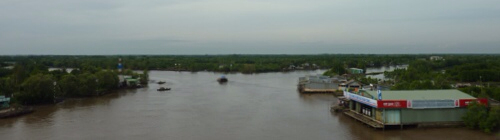
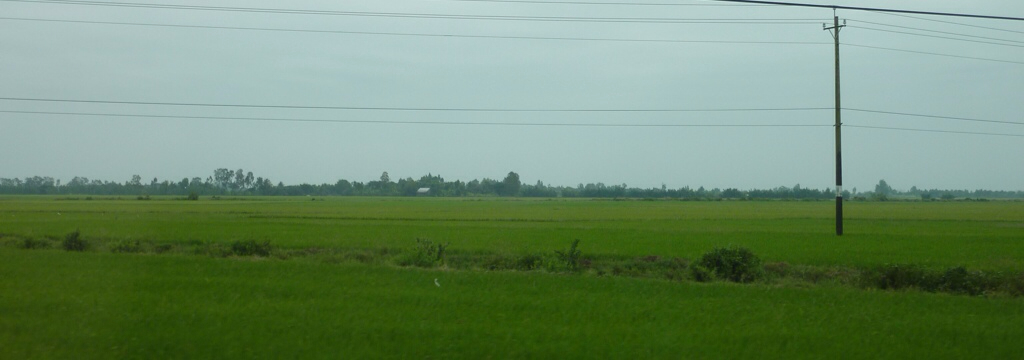
The Mekong delta is just about the flattest region in Vietnam. In some places, where extensive green rice fields stretched between lines of trees that marked the otherwise perfectly straight horizon, we almost felt like we were back in Holland. A place as flat like this must be as exposed to floods as The Netherlands.

And it is. Even fresh-water areas here have a strong tidal variation. Usually the people take advantage of the steady rising and falling of the water level, irrigating their rice fields and catching small shrimp to grow further in ponds and baskets. Water is central to life in the Mekong delta: until the government improved road infrastructure, most transport took place by boat. The floating markets around Can Tho are popular tourist destinations. But the water is a treacherous friend. In 2000 the Mekong raised about 5 meters high, submerging hundreds of thousands of houses, and drowning hundreds of people as well as cattle and crop. The area saw another big flood in 2011.

Expectations are that the flooding problem will get worse as the global climate gets warmer, bringing heavier rains and a higher sea level. But even a climate change skeptic should be able to see the importance of learning to deal with these heavy floods. Much of what the inhabitants can do makes sense even if no climate change occurs: strengthening dykes, building higher or stronger houses, buying insurance to cover the financial risks of crop and cattle loss. One of the big questions is what the government can or should do (planned adaptation in jargon), and what the local residents do (autonomous adaptation).

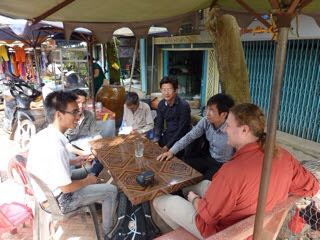
Binh is the smartly dressed gentleman in the center.
The ponytailed Dutch guy in the ugly red shirt, that would be me.

One of our PhD students, Phung Thanh Binh, does his research on flood insurance in the Mekong delta, under the supervision of my colleague Zhu Xueqin and myself. Are local residents interested in getting flood insurance, and if so, under what conditions? What insurance premium are they willing to pay for a little bit more coverage? If they have flood insurance, will they still prepare for floods or will they transfer some of the risk to their insurance company?

It was good to visit Binh’s research site, and to see how he conducts his survey. I had not realised how complicated such surveys can be around here: just going from door to door, as you would do in countries like Kenya and Tanzania, is unlikely to work for several social and cultural reasons. Binh invited, through local authorities, respondents to come to the local community office where one of Binh’s research assistants would interview them. It seems I have a lot to learn still about doing research in southeast Asia.

Fingers crossed now

I presented my research vision to the “Severe Assessment Committee”, i.e. the ladies and gentleman who decide on my position at Wageningen University, last Tuesday. Due to the timing of my contract their decision is a bit more complex than it would otherwise be. Usually they decide whether a candidate gets tenure as an associate professor, but in my case they need to decide whether I can become an associate in one year’s time. It’s a long story.

Anyway, I think the presentation and the discussion went well. You can find my slides here, in case you’re interested.

Fingers crossed now.

Greetings from the delta

The last four weeks Monique and I spent our Christmas and New Year’s holiday in Vietnam. We made it a holiday combined with a little bit of work: we started in the North, where we met one of my PhD students, Trinh Quang Tu, and visited such tourist destinations as the Mai Chau valley, Tam Coc, and Ha Long Bay. After a few days in the ancient city of Hué and the picturesque merchant town of Hoi An we continued to Ho Chi Minh City, from where we travelled to the Mekong Delta. In the Mekong Delta we had reserved some time to meet people at Can Tho University, visit aquaculture farms in the regions where Tu does his research, and to visit one of the research sites of another PhD student of mine, Phung Thanh Binh. In the following weeks I will post my impressions of my trip.

Vietnam is a magnificent country, with wonderful people, stunning views, delicious food, and a fascinating history. Despite the obvious traces of a millennium of Chinese domination and a century of French domination, the Vietnamese have a strong sense of independence. I think the Dutch and the Vietnamese have something in common: two relatively small countries, surrounded by big powerful neighbours and the deep blue sea. During the Anglo-Dutch wars the English called the Dutch ‘frogs’ because of our wet and muddy natural habitat (they later later applied the same pejorative to the French, but then for culinary reasons). I like to think there is a similarity between the Dutch frogs in their cold Rhine and Meuse delta, and the Vietnamese tortoise, a mythical specimen of which provided a magic sword to Le Loi, the Vietnamese emperor who kicked the Chinese Ming dynasty out of Vietnam, in the tropical Red River and Mekong deltas.

But Vietnam is also a country in transition from a poor communist economy to a bustling capitalist economy, with all the environmental and social issues associated with that process. You can see beautiful big houses next to crumbling shacks. Small businesses everywhere, Pepsi and Samsung billboards next to Communist propaganda posters. New infrastructure is being built, and shiny new office buildings. Streets and shores are littered with plastic bags and bottles. Both deltas are under threat from upstream dam construction in neighbouring countries, and from climate change. Large areas of mangrove forest have been cut to make room for shrimp farms. And don’t forget the motorbikes. You cannot escape the motorbikes, buzzing their way through the streets like angry hornets with vehicle horns.

And no, I am not going to mention the war.

Why economists argue with ecologists (5): The Suzuki fallacy

I quit smoking when I was about 30 years old. It is an unhealthy habit, of course, but I also disliked the idea of being dependent on my stock of tobacco. One of the few things I miss about smoking, however, is the excuse to go outside during a break and have a fag and a chat with a few likeminded nicotinists. So occasionally I go outside with the addicts and have the chat without the fag.

I did this a while ago with an ecologist who started a long complaint about economists’ ignorance of the limits of our planet. Economists, he claimed, refer to environmental problems as ‘externalities’: they think the environment is external, i.e. irrelevant, to the economy. I tried to convince him how he misunderstood what externalities are, pointing to his sigarette. It may be his own choice to light a cigarette, or something between him and his dealer to buy a pack of cigarettes, but I also had to inhale his smoke. The damage that he thus inflicted on me was a negative externality: a cost that did not show up on his mental ‘balance sheet’. Perhaps, if he had to pay a tax for each of my lost lung cells he would have made a different choice. (You know what they say: nobody is purer than an ex-prostitute.)

I doubt whether I convinced him, but in any case his comment had me thinking. Where did he get this ludricous idea that the economic term ‘externality’ means ‘irrelevant’? After all, every introductory microeconomics book has a chapter on how externalities are a form of market failure. Then I saw this clip.

My toes still cringe when I watch this – it’s just too embarrassing. When he talks about ecosystem services:

All of the things that nature does for us, for nothing. Pollination, for example, or a forest that takes carbon dioxide out of the air and puts oxygen back in, or that holds the soil and prevent erosion.

That’s the point where I would have expected an explanation that these services are unpriced, and that we should make those services visible in the market place. For instance, by putting a price on them in public decisions, or by levying environmental taxes, or through paying the owners of the ecosystems for the services they provide. But somehow he got it into his head that

All those services that nature performs, economists call them “externalities”. And what that means is: “they got nothing to do with the economy. We don’t put a price on them, they are irrelevant.”

The speaker, David Suzuki, is a famous environmentalist. He should know his stuff, but he is making these statements without a single speck of irony, and apparently he has been doing this for years. Of course there is lots of nonsense spouted on the internet and you don’t have to react to everything, but people like my smoking ecologist listen to David Suzuki. I don’t mind criticism of economic theory, in fact I think a lot can be improved. The nice thing about interdisciplinary work is that you learn not just about the contents of other disciplines, but also their way of doing science. And this reflects back on your own discipline. But such cooperation is not helped if people start spreading this kind of prejudice and misunderstanding about one of the fields involved.

I played the fiddle in a Prague biker bar

So this is Bajkazyl:

It started out as a bicycle repair workshop but since last year they have a bar and live music almost every evening. Prague has a small but growing scene with young people interested in traditional Breton and Czech dances, so we played some Breton, French, Dutch and Czech tunes and pissed off a lot of cyclists doing that. Prague has a wonderful liberal atmosphere: any Dutch bike repair workshop trying this would have its ass sued to hell within a week.

Why Grow Fins?

I’ve been following a number of economics and science blogs for some time now, and I gradually became convinced that the importance of blogging in the scientific debate can only get bigger in the near future. Read, for instance, this article in The Economist about how blogging is shaping macroeconomics debates, or David Zetland’s thoughts on blogging in academia. Speed is an obvious advantage: it can take a year to publish a paper in a peer-reviewed journal, and a couple of weeks to publish in policy-oriented journals such as ESB, but a blogpost can be up in a few minutes. (Admittedly, not having to get your ideas past an editor also helps.) Moreover, as the Economist article argues, blogging has helped extend the academic debate to include some fairly wild ideas that would have been a lot more difficult to express in a respected peer-reviewed journal. Perhaps closer to my field of interest, I see the same happening in the climate debate. I’m not a climate sceptic, but I believe it is a healthy thing to be exposed to views contrary to your own, such as those expressed on, say, Watts Up With That? or, in my own native language, Climategate.nl. Lastly, blogging is a great way to communicate with students and anyone outside academia. (So next time I don’t feel like talking about work at birthday parties I can refer people to this blog.)

Then, you might still wonder, why ‘Grow Fins’? My main research interest lies in the economics of marine and coastal ecosystems. The most fundamental insights in fisheries economics were already published in the 1950s, but as economic activity in coastal and marine zones is getting denser, and the range of goods and services we take from these ecosystems widens, there is still a lot of work to do for the dismal science. I intend to use this blog to highlight some of the work I am doing in this domain, which includes teaching resource economics courses to BSc and MSc students, and doing research (or supervising PhD students) on such issues as fisheries management, invasive species, and valuation.

Another reason for this name is that I’m a great fan of weird fringe music such as Captain Beefheart, Italian psychedelic doom metal, Californian stoner-bluesrock, Ethiopian jazz, English Morris-on-steroids, French traditional dance music, and Flemish folk music. So expect the occasional rant about some obscure band, artist, or festival.