A year of Grow Fins

I started this blog a year ago today. I didn’t have any expectations when I started it (I still don’t), so it’s difficult to say whether I’m satisfied with the frequency and the quality of my posts, the reactions, and the readership. But let me try to say a few things.

First of all, I have noticed that blogging forces me to think about the relevance of the work I do. If I go to a conference, what do I learn that I can explain to a lay person? If I publish a paper in a peer-reviewed journal, how does it relate to a non-academic reader? Another thing is that it forces me to follow not just the scientific literature, but also the public debate. Shortly after starting this blog I opened a Twitter account, and this is a great way to keep track of the debate if you manage to sift through the non-news from some users (look everyone, new boots!) and feel-good tweets from others (did you hug a tree today?). I follow the online news of some Dutch and UK newspapers but I don’t have a high esteem of most of them, except for The Economist, which is the only newspaper I actually pay for. But most news on fishing and other marine issues is too obscure to be published in any of these newspapers anyway, so that most of what you do read is based on press releases from environmental NGOs, or from scientific journals (Nature and Science, basically) that like to publish oversimplified and overgeneralised research (2048, anyone?). Twitter fills this gap nicely.

Second, I try to write one post per week but that’s more difficult than I thought. I cannot begin to grasp how David Zetland writes about 4-5 posts per week. (Perhaps I should write shorter posts, I know.) Sometimes I publish more, sometimes I write more but I save the posts for later. During my Vietnam trip I did this on purpose in order to publish them after my return. (Burglars have internet access, you know.)

Third, Blogger keeps the stats of its blogs so I can get some idea of what has been read and what has not been. In the past year I posted 78 posts, which altogether were read 3196 times. That may seem like a lot (almost 40 reads per post) but the numbers include a bot attack that generated a lot of artificial traffic. Keeping that in mind, the top 5 of most frequently read posts is:

Why economists argue with ecologists (4): Economics and thermodynamics 105
Yet another scientific fraud scandal in the Netherlands 85
Stuff I do: marine invasive species 56
At least they read my CV 48
The Stapel affair: it is worse than we thought and
The Living Planet Report (2): Ecological Footprint makes for nice reading but abominable science
46

One thing to mind, of course, is that older posts have had more time to be read, and hence get more reads, than newer posts. Here are the most used search terms that led readers to my blog:

grow-fins.blogspot.com
dirk smeesters, dirk smeesters fraud, stapel smeesters, dirk smeesters cv
25
choke species, “choke species” 18
blog “marine economics” 10
laura dean acquisition editor
why economists argue with ecologists
5

I’m honoured people actually searched for my blog, although I wonder why you would search for a url rather than type it into the address bar of your browser. The two scientific fraud affairs (Diederik Stapel and Dirk Smeesters) were a lot in the news last year, which explains why people search for them, which explains the number of reads for my posts on this topic. Lots of scientists must also be wondering who is Laura Dean, and I’m happy that at least some people found my post where I referred to another blog that explains why this name is associated with one of countless predatory publishers.

But what I like most is that people searched for information on choke species, differences between economists and ecologists, and ecological footprint (not shown here), and found my blog. I know, if all those people were in one class room and I would be teaching them I’d call it a very small class. But it’s enough for me to keep on blogging.

Tenure, sort of

OK, it’s official now: after a working life of about 15 years I will finally have my indefinite contract at Wageningen University. So while teaching (a lot), publishing (less than I should/want to), attracting research funding (more than I dared dream of), and presenting and writing my research vision to the advisory committee, I must have done enough right to convince the committee that the university should keep me. The committee will reconvene in about a year, however, to decide whether I’m good enough to be appointed associate professor.

So yes, I’m happy that I can continue with what I am doing, and that I can further develop my line of research here. I like Wageningen University, although I admit that the only other universities I have ever worked at were Tilburg University, where I did a post-doc from 2006 to 2008, and UC Santa Barbara, where I have spent a sabbatical in 2010. The environmental economics tradition in Tilburg is much more theoretical and monodisciplinary than the one in Wageningen. Admittedly, they publish more in the top journals like JEEM, ERE, or REE than we do, and I think we should have the same ambition. On the other hand, the tradition in Wageningen is more problem-oriented, more involved in developing countries, and more interdisciplinary. I feel the Wageningen approach suits me better.

How do I feel about the whole tenure track system? A lot of people complained before, during, and after its introduction. And yes, I’m one of them, but I’m convinced it’s better than my university’s old system. The elementary particle of Wageningen University’s institutional structure is the chair group, which comprises a scientific discipline or subdiscipline such as aquatic ecology, environmental systems analysis, or environmental and resource economics. The head of a chair group is the chair holder, and in the old days the chair holder was mostly the professor of the chair group. There were some personal professors, but mostly these positions were created by the management, after which a suitable person was recruited. In other words, staff smart and ambitious enough to become a professor had to wait for the chair holder to leave, and hence mostly left before the chair holder did. I’m sure there was a way of getting rid of truly disastrous professors, but mediocre professors could remain unchallenged for their entire career because the smarter staff went elsewhere. The old system was a recipe for stagnation and intellectual laziness.

At least tenure track offers the staff that would have left under the old system a path towards professorship inside Wageningen University. This raises the question how many professors a university can pay, and this question has been asked repeatedly. I don’t know how the university expects to pay for all these people, but my experience in Tilburg, which at the time employed about three professors in environmental and resource economics (besides a host of others in microeconomics, experimental economics, and what not), is that tenure track can develop the organisation into a healthy market for ideas. As far as I could see the professors in Tilburg seemed colleagues rather than rivals, although I guess there must have been some form of competition for funding and the brightest students. They exchanged ideas, read and commented on each other’s papers, and wrote papers together. (The Dutch language has a great word for this: conculega, a portmanteau of the Dutch words for competitor and colleague.) I think that is a much healthier situation than the little monarchies we have had so far in Wageningen.

So if I think tenure track is an improvement, what do I complain about? Partly the way it is implemented; partly the typical problems you always run into when you introduce a new system; partly the logical disadvantages of tenure track. Wageningen University tenure track staff is expected to meet 18 different benchmarks, including teaching load, teaching evaluation scores, funding, publications, and PhD supervision. Originally these benchmarks were set by natural scientists and applied to social science, but this has been corrected, up to a point. A lot of criteria are unclear; some information we get is self-contradictory. This all shows that the organisation is still learning from its experiences, and I’m sure they’ll get it right someday. Nevertheless, it makes you feel like a cross between a front soldier and a guinea pig. More fundamentally, publish-or-perish has enhanced the risk of academic fraud and created a boom in predatory open-access publishers. We will have to be more vigilant with respect to plagiarism, falsification, and fabrication of data. (I’m tempted to refer again to Tilburg here, but I won’t: first, Diederik Stapel wasn’t at the Economics Department; second, his fraud has taken place on such a massive scale and over such a long time that I don’t believe publish-or-perish was the main reason.)

Going deep south

The day we arrived in Hanoi, Tu invited us at his home to get a taste of genuine Vietnamese biodiversity: swimming crab, carp, blood cockles, tiger shrimp, squid and some other species I don’t remember. Like many Asians, the Vietnamese like their seafood fresh: everything except the carp and the squid was alive (and moved). It was served around a big bowl of broth, with tomato, ginger, pineapple, and lemongrass, where everything was cooked and the broth slowly became a delicious fish soup: say hello to the Vietnamese hotpot.

As far as I could see, all of the seafood served came from aquaculture – not a big surprise in a country that ranks third in global aquaculture production. Tu works at the Vietnamese Research Institute for Aquaculture as a fisheries economist, and he does his PhD research at our group on how the shrimp farmers in the Mekong delta adapt to climate change. Expectations are that as sea levels rise, and average temperatures increase, shrimp farmers will increasingly have to deal with disease outbreaks and salt water intrusion (black tiger shrimp are a bit like Goldilocks, preferring their water not fresh, not salty, but brackish). How will these farmers deal with these problems? In other words, what kind of autonomous adaptation will they implement, and what kind of planned adaptation can or should the government implement?

I had discussed these issues at length with Tu over the last twelve months or so, but it is difficult to discuss these issues if you have never seen these farms in reality. So Monique and I reserved a few days to travel to Soc Trang, Bac Lieu, and perhaps Ca Mau, where most of the Mekong Delta’s shrimp come from. We were joined by Tu, Le Xuan Sinh (an aquaculture expert from Can Tho University) and Nguyen Trang (a master student at Wageningen University who does her thesis work in the Mekong Delta). Sinh suggested to drive along the coast road between Soc Trang town and Bac Lieu town the first day, and stay the night in Ca Mau town. The day after we went deep south: by car to Nam Can (the most southern town of Vietnam that can be reached by car), and then the boat all the way to Mui Ca Mau (the southern cape of mainland Vietnam).
 
No matter how much I had read about Vietnamese shrimp farming before I came, it still struck me how different the shrimp farms in different regions are, and how strongly these differences depend on their natural environment. The relatively fresh waters of Soc Trang allow for intensive shrimp farming, in many cases even with systems where the pond is perfectly separated from the water or canal. These are fairly capital-intensive systems, with neatly dug ponds, aeration devices, and much use of shrimp feed and other inputs. These farmers have the system quite under control.
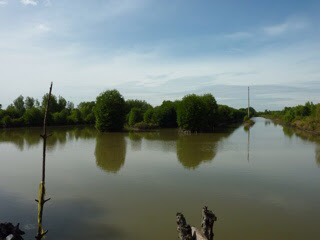
How different are the farms you find deeper south, in the vast mangrove forests of Ca Mau province. The water is much more brackish here, so that the ponds are more strongly connected to the rivers and canals. Farmers let water in or out to control the salinity of the water, and in some cases to take in shrimp seed and fish. In the center of the pond you find planted mangrove trees that provide food and shelter to the shrimp, and that are usually sold after about 15 years for firewood or charcoal. The farmers use little feed because the shrimp can feed on algae growing on the mangrove trees.
 
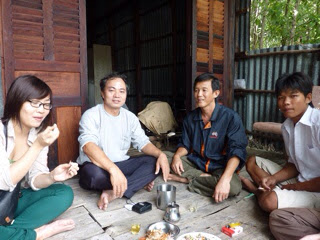
Apparently our visit was quite an event for this farmer. He invited us for a meal of cooked crab and some sort of Vietnamese jenever. Even though it was 11am we bravely jugged the stuff down because it would have been impolite to refuse. So here you have another problem of doing field work in Vietnam: you need to be able to drink. Heavily. All the more reason to let the respondents come to some central place instead of going from door to door yourself.
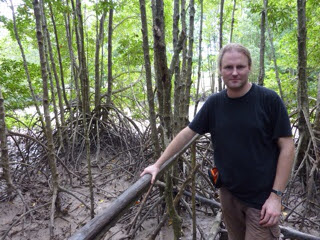
Although it is hardly featured in tourist guidebooks, I consider Ca Mau one of the highlights of my trip to Vietnam. Of course for being invited to food and drink with some shrimp farmer, and for the thrilling boat trip through the mangrove forests to Mui Ca Mau, but also for the mangrove forests themselves. I just love mangrove forests. The sheer fact of having a forest in such a salty, tidal area, with stilt-roots sticking in the mud. And when you look closely, at any square meter of the mud between the trees, you see the forest is teeming with life. Different species of crabs crawl over the bottom. A snake slithers by. Mud skippers skid over the puddles of brown water at the edge of the forest.
 
So what have I learned from this trip? First of all, there is no one-size-fits-all solution for Vietnamese shrimp farms to deal with medium-term or long-term changes in their natural environment. Adopting a closed system, or cultivating white leg shrimp (a hardy species from South America) instead of black tiger shrimp, may work for the intensive farmers in Soc Trang but not for the extensive farmers in Ca Mau. Second, there is a looming problem in almost all shrimp farms: the waste coming from the pond. Farmers regularly clean the ponds, and then a muddy mixture of shrimp faeces and salt comes out. It may have been a good fertilizer if it weren’t for its salinity. So far no solution has been found for it yet, so all farms have a load of salty mud piling up. The farmers are not allowed to dump the mud in the river, but monitoring and enforcement is weak and the farmers have little alternative. Third, another problem is that the stock of wild shrimp is declining as more and more farmers catch wild shrimp seed in order to cultivate it in their ponds. Wild shrimp tend to be more disease resistant, but there is of course only so much that the local ecosystem can provide. Fourth, conducting a survey in areas like Ca Mau is going to be a daunting task: getting there over water, identifying and randomly selecting respondents, and last but not least staying sober.

February: my crazy teaching month

I’m having a crazy week of teaching this week. I’m teaching two lectures on fisheries economics tomorrow; an R practical in fisheries economic modelling and a lecture on dynamic programming on Wednesday; and a practical in dynamic programming in R and a lecture on ecosystems complexity on Thursday. Meanwhile I’ll be hosting a guest lecture on Wednesday (a speaker from Shell on energy policy) and on Friday (a speaker from Statistics Netherlands on environmental statistics). Next week I’m teaching two lectures on green national accounting, one on fisheries economics (different course), one on cost-benefit analysis, and hosting another two guest lectures.

It’s like this every year, but I enjoy it as much as it is exhausting. February is a very short teaching term at my university (don’t get me started on the merits, or lack thereof, of our academic calendar), where students are supposed to study one course, full time, in three to four weeks. I contribute to two courses in this term: one MSc course about natural resource economics and one at BSc level where we present six current topics in environmental economic policy from the viewpoint of academics and that of the real world. In the first course I get to tell students all about the topics I deal with most of my research time (fisheries economics, dynamic optimisation, ecosystem management); in the second course I can invite speakers to discuss the nitty-gritty of environmental policy-making with students. What’s not to like?
By the way, in addition to the R practical I revised my introductory text on dynamic programming after seeing how it worked at last year’s practical (not at all). As always, comments are welcome.

Dealing with flood risks in the Mekong delta

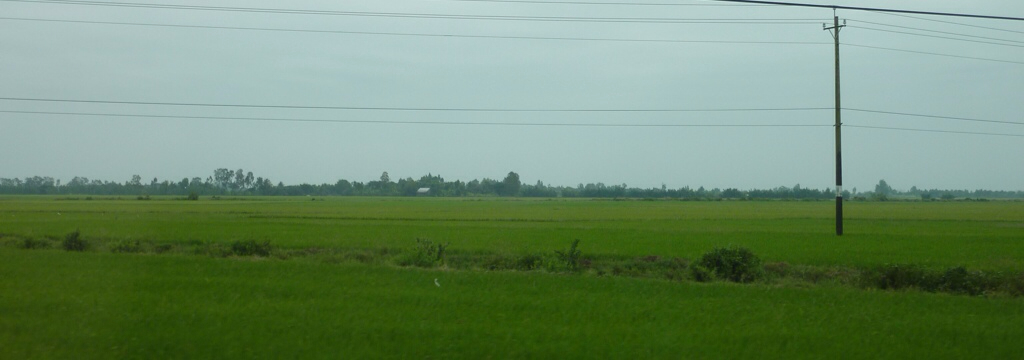
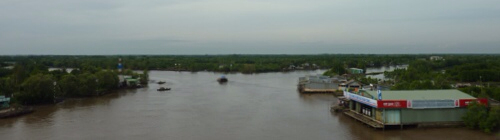
The Mekong delta is just about the flattest region in Vietnam. In some places, where extensive green rice fields stretched between lines of trees that marked the otherwise perfectly straight horizon, we almost felt like we were back in Holland. A place as flat like this must be as exposed to floods as The Netherlands.

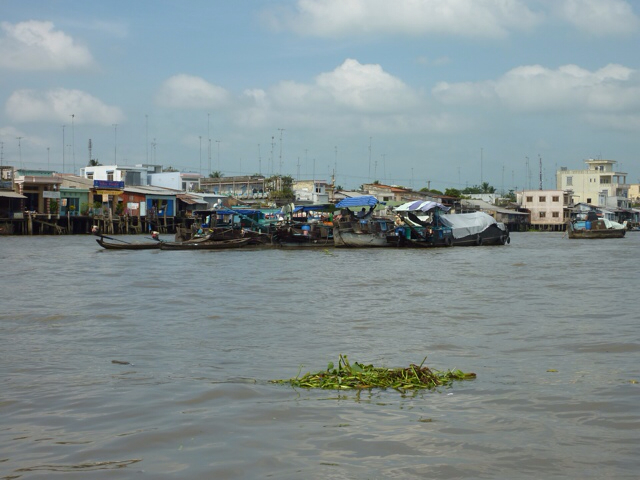
And it is. Even fresh-water areas here have a strong tidal variation. Usually the people take advantage of the steady rising and falling of the water level, irrigating their rice fields and catching small shrimp to grow further in ponds and baskets. Water is central to life in the Mekong delta: until the government improved road infrastructure, most transport took place by boat. The floating markets around Can Tho are popular tourist destinations. But the water is a treacherous friend. In 2000 the Mekong raised about 5 meters high, submerging hundreds of thousands of houses, and drowning hundreds of people as well as cattle and crop. The area saw another big flood in 2011.

Expectations are that the flooding problem will get worse as the global climate gets warmer, bringing heavier rains and a higher sea level. But even a climate change skeptic should be able to see the importance of learning to deal with these heavy floods. Much of what the inhabitants can do makes sense even if no climate change occurs: strengthening dykes, building higher or stronger houses, buying insurance to cover the financial risks of crop and cattle loss. One of the big questions is what the government can or should do (planned adaptation in jargon), and what the local residents do (autonomous adaptation).

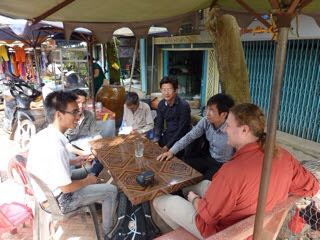
Binh is the smartly dressed gentleman in the center.
The ponytailed Dutch guy in the ugly red shirt, that would be me.

One of our PhD students, Phung Thanh Binh, does his research on flood insurance in the Mekong delta, under the supervision of my colleague Zhu Xueqin and myself. Are local residents interested in getting flood insurance, and if so, under what conditions? What insurance premium are they willing to pay for a little bit more coverage? If they have flood insurance, will they still prepare for floods or will they transfer some of the risk to their insurance company?

It was good to visit Binh’s research site, and to see how he conducts his survey. I had not realised how complicated such surveys can be around here: just going from door to door, as you would do in countries like Kenya and Tanzania, is unlikely to work for several social and cultural reasons. Binh invited, through local authorities, respondents to come to the local community office where one of Binh’s research assistants would interview them. It seems I have a lot to learn still about doing research in southeast Asia.

Crystal ball gazing, the academic way

The excitement of international science workshops

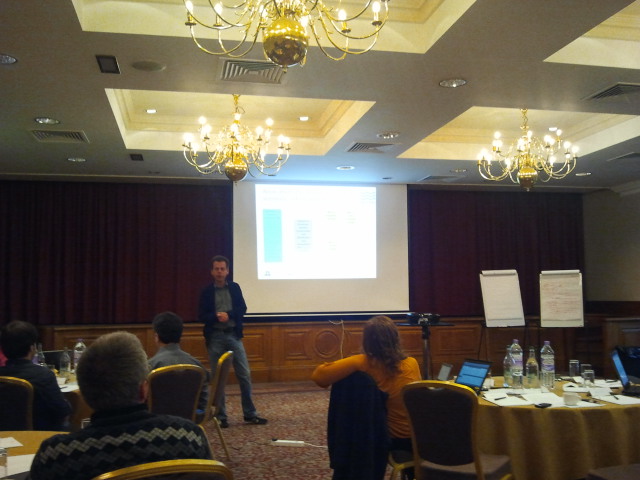
So I’m in this international research project VECTORS, dealing with many exciting and fascinating issues, working with scientists from all over Europe. But if I tell you I was at a VECTORS workshop in Edinburgh last week, it’s not exactly like we were sipping 40 year old Talisker in Edinburgh Castle with Queen Elisabeth. A business hotel near the airport is more like it: easier to reach, lots of meeting rooms, good food, and no distractions.

Scenarios were the main theme this time. A lot of the developments that VECTORS deals with are highly uncertain. How warm (or cold) will our waters be in the coming 50 years? How many sunbathers will visit Mediterranean beaches? How many international transport vessels will visit the ports of Rotterdam and Antwerp?

You may be tempted to address these questions through some sort of sensitivity analysis: do your calculations for different values of the uncertain variables, or rather, combinations of different values. If you know the probability of some outcome of some variable (say, “the probability that temperatures increase by 1 degree or more is 30%”) you could estimate the probability of some outcome of your models’ output (“the probability that average income increases by €100 per month or more is 50%”). But you will run into a number of problems:

  • You don’t know probabilities.
  • Even if you knew the probabilities they would not be independent. A high nutrient load is more likely if there are many people around spending their money on lots of meat or highly fertilised crops than if the population is small and poor.
  • The number of possible combinations grows exponentially with the number of variables. Suppose you want to consider three levels of each variable. Then one variable gives you three possible outcomes; two variables have nine possible outcomes; three variables have 27 possible outcomes; 10 variables have 59,049 possible outcomes. And then the ecologists in your team tell you that running one such outcome on their model takes one month. So if you have 5000 years you can do a sensitivity analysis of all 10 variables!
  • There are many other possible developments that are difficult to capture in numbers, such as changes in regulations, customs, technologies, and so on.
  • Policy makers have neither the time nor the energy to read your entire sensitivity analysis. They want something you can summarise in one page (which they skim rather than read).

So what do we do? We develop scenarios. But what are scenarios?

A scenario is not a prediction of the future. It is more like a story line that describes how the world might develop in the future, taking into account different possible trends. It should be consistent, and ideally you have a set of scenarios that spans a fairly wide range of possible developments.

A scenario is not a policy option. When you see the different scenarios from, say, the IPCC, you may be tempted to say: “let’s go for this one.” But although you may certainly like some outlooks more than others, the idea is that you don’t know which one will come true – and you have no influence on which one comes true.

At least, scenarios can help us to make sense of the complexity of the different social, economic, political, and biophysical changes that may take place in the future. A few consistent story lines are easier to understand than countless histograms and plots, for scientists as well as policy makers. And they still allow us to explore how different policy choices may work out in the future.

At some point I joked that we should have Philip Pullman write our scenarios, but I was only half joking. It’s at least as much an art as it is a science.

Glorifying poverty?

It’s an inevitable part of economic development: as infrastructure is improved, and capital is accumulated, and production processes and markets become more efficient, old ways of doing things disappear. There is a nostalgic Irish song that puts it quite well:

By trade I was a cooper;
lost out to redundancy;
like my house that fell to progress
my trade’s a memory

The song played through my mind all the time when we saw what was left of the floating market of Cai Be, in the Mekong delta. Our guide told us the once famous floating market was disappearing rapidly in favour of the land-based market now that infrastructure in the region has been much improved. That is perhaps a shame, but perhaps it’s also shameful that we think it’s a shame.

Like the wooden barrels and casks they used to make, there are few coopers left in our modern economy. We store our beer in aluminum kegs now: much more durable, much more hygienic, much more efficient. But as tourists, we lament the demise of the old ways, for they make our holiday destinations ‘charming’ and ‘exotic’. We curse progress when floating markets are replaced by supermarkets, when thatched roofs turn into corrugated iron, or when small-scale fishers get a job at an industrial-scale purse seiner.

But much of what we find charming is in fact a sign of poverty. Many people in developing countries prefer a corrugated iron roof over a thatched one, and they will get it as soon as they have the money to buy it. Floating markets emerged due to lack of good road infrastructure. Those men playing Chinese chess in a local Vietnamese coffee shop? You may call it the good life, but you might as well call it unemployment.

Yes, as developing countries get richer they start looking more like us: there will be more shops (more chain stores, also, unfortunately), more cars, fewer street stalls, better infrastructure, cleaner streets. Prosperity is often accompanied by a certain cooling of interpersonal relations as people become busier, more efficient, and more business-like. Some of these changes are to be welcomed (better health care, cleaner streets), some changes may be a necessary price to pay for the welcome changes (more efficiency, less surprises), some changes are to be lamented (loss of traditions, old professions that become folklore at best).

But honestly, should they stay poor so you can make pretty pictures?

The Prisoner’s Dilemma in traffic

Witnessing the traffic in Vietnam, whether it was the madhouse on the streets of Hanoi or the exasperating driving style of motorists on the highway, I realized that traffic is very much a Prisoner’s Dilemma. The overall motto in Vietnamese traffic is every man for himself. Drives prefer the left lane and adamantly refuse to let others overtake them. Be careful when you cross the street, even at green pedestrian traffic lights: red traffic lights are considered no more than suggestions so you might still be run over by one of the countless motorbikes.

It made me realise that in everyday traffic there are a lot of occasions where you can gain some benefit at the expense of other road users: cross a red light, overtake somebody on his right side, don’t let others pass or enter the highway. On the short term you may benefit from this behaviour, but if everybody behaves this way we are all worse off than if we would just show a little courtesy. You can see the result in many of Vietnam’s streets: congested roads, traffic accidents, aggressive drivers. A game theorist would say that Vietnamese traffic is somewhere in or near its Nash equilibrium (nobody has a reason to change his or her individual behaviour, given the behaviour of others), but the Nash equilibrium is not Pareto optimal (everybody would be better off if everybody behaved differently): the textbook definition of a Prisoner’s Dilemma.

In countries like Norway or the United States, however, the traffic seems much more organised (Dutch drivers, I must confess, are less courteous, but yet more so than Vietnamese drivers). Why don’t Norwegian drivers and American drivers obey our microeconomic models by behaving more aggressively? (I don’t mean to insult Vietnamese motorists, so let’s call it driving assertively.) I believe hefty fines are only part of the explanation. It is also that Norwegian and American motorists consider it bad behaviour: in other words, there are social norms that keep them from driving more assertively.

Another interesting observation is that a Norwegian wouldn’t get anywhere in downtown Hanoi unless he drives like a Hanoian. So once this assertive way of driving becomes the norm it will be very difficult to change it to a more courteous norm. Assertive drivers may get somewhere in Oslo, but perhaps their friends would tell them off for their driving style. In any case many Norwegians consider it bad form, and people have a natural tendency to conform to the dominant norm. So there are self-enhancing mechanisms that keep the dominant social norm in place.

So to understand Elinor Ostrom’s work you don’t have to go to the irrigated rice fields of rural Bangladesh: just get a driver’s license.


Fingers crossed now

I presented my research vision to the “Severe Assessment Committee”, i.e. the ladies and gentleman who decide on my position at Wageningen University, last Tuesday. Due to the timing of my contract their decision is a bit more complex than it would otherwise be. Usually they decide whether a candidate gets tenure as an associate professor, but in my case they need to decide whether I can become an associate in one year’s time. It’s a long story.

Anyway, I think the presentation and the discussion went well. You can find my slides here, in case you’re interested.

Fingers crossed now.

Greetings from the delta

The last four weeks Monique and I spent our Christmas and New Year’s holiday in Vietnam. We made it a holiday combined with a little bit of work: we started in the North, where we met one of my PhD students, Trinh Quang Tu, and visited such tourist destinations as the Mai Chau valley, Tam Coc, and Ha Long Bay. After a few days in the ancient city of Hué and the picturesque merchant town of Hoi An we continued to Ho Chi Minh City, from where we travelled to the Mekong Delta. In the Mekong Delta we had reserved some time to meet people at Can Tho University, visit aquaculture farms in the regions where Tu does his research, and to visit one of the research sites of another PhD student of mine, Phung Thanh Binh. In the following weeks I will post my impressions of my trip.

Vietnam is a magnificent country, with wonderful people, stunning views, delicious food, and a fascinating history. Despite the obvious traces of a millennium of Chinese domination and a century of French domination, the Vietnamese have a strong sense of independence. I think the Dutch and the Vietnamese have something in common: two relatively small countries, surrounded by big powerful neighbours and the deep blue sea. During the Anglo-Dutch wars the English called the Dutch ‘frogs’ because of our wet and muddy natural habitat (they later later applied the same pejorative to the French, but then for culinary reasons). I like to think there is a similarity between the Dutch frogs in their cold Rhine and Meuse delta, and the Vietnamese tortoise, a mythical specimen of which provided a magic sword to Le Loi, the Vietnamese emperor who kicked the Chinese Ming dynasty out of Vietnam, in the tropical Red River and Mekong deltas.

But Vietnam is also a country in transition from a poor communist economy to a bustling capitalist economy, with all the environmental and social issues associated with that process. You can see beautiful big houses next to crumbling shacks. Small businesses everywhere, Pepsi and Samsung billboards next to Communist propaganda posters. New infrastructure is being built, and shiny new office buildings. Streets and shores are littered with plastic bags and bottles. Both deltas are under threat from upstream dam construction in neighbouring countries, and from climate change. Large areas of mangrove forest have been cut to make room for shrimp farms. And don’t forget the motorbikes. You cannot escape the motorbikes, buzzing their way through the streets like angry hornets with vehicle horns.

And no, I am not going to mention the war.