Worried about climate skeptics? It can be much, much worse

John Whitehead of the Env-Econ blog has the following about a new bill in North Carolina:

Business interests along the state’s coastline pushed lawmakers to include language in a law that would require future sea level estimates to be based only on data from past years. New evidence, especially on sea level rise that could be tied to global warming, would not be factored into the state’s development plans for the coast.

The proposal has been described by some as “criminal”, but the first that sprang to my mind was the infamous Indiana bill that set π equal to 3.2.

It’s going to be an interesting EAERE this year

Whoever is bored of the EAERE welcome reception and wants to hear some weird music: I’ll be playing that evening in Prague with these guys:

Meet L’Arrache-Coeur, a Czech group playing a very liberal interpretation of French trad music and klezmer. The guy playing the hurdy-gurdy (that’s the instrument that looks like a cross between a fiddle and a coffee grinder) is Daniel Kahuda: Daniel stayed in Wageningen a few years ago, where he was a regular visitor of our monthly folk session.

Some years later I was in Prague for the European Congress of Conservation Biology (with very mixed feelings, I must say – see my posts on economics vs ecology). We met up and had a few great gigs and sessions. Here is a picture taken at the Grabstejn World Fest, where we played with L’Arrache-Coeur’s accordion player František Tomášek and Puck Duits, who is one of Holland’s best bagpipe players.

Anyway, L’Arrache-Coeur is playing on Wednesday evening 27 June, and Daniel invited me to join them. The place is called Cafe-Bar Bajkazyl, and apparently it’s a cross between a bar and a bike rental. I have no idea what I’m getting myself into, but I’m sure it’ll be fun. Environmental and resource economists welcome.

Elinor Ostrom: 1933 – 2012

From the Environmental Economics blog (who got it from Indiana University):

The entire Indiana University community mourns the passing today of Distinguished Professor Elinor Ostrom, who received the 2009 Nobel Prize in Economic Sciences for her groundbreaking research on the ways that people organize themselves to manage resources.

This is a very sad day for natural resource economics. Elinor Ostrom single-handedly demolished the Tragedy Of The Commons paradigm: whereas textbook economics tells us that common pool resources will eventually be depleted, she described plenty of counter-examples where they were managed fairly well. Her work was so unique many economists simply refer to it as “Elinor Ostrom’s work”.

She will be sorely missed.

The Living Planet Report (2): Ecological Footprint makes for nice reading but abominable science

WWF’s latest Living Planet Report presents a bleak picture, some hopeful trends, an awfully bad indicator and lots of pious words on sustainable development.

Oh boy: the Ecological Footprint

NGOs like WWF love indicators like the Ecological Footprint. Its message seems simple: if we want to continue living the way we do now, we need more planets to offset all the bad thing we do. Alas, it is one of the worst concoctions that ever came out of an econophobic environmentalist’s imagination. At best it tells us things we already know. At worst it suggests policies that are harmful to people AND the environment. It is claptrap. Trash. Ecological Footprint is evil. The objections are legion, but the main ones are:

  • EF tells us nothing about how “bad” or how “serious” impacts are;
  • It depends strongly on carbon emissions and makes wildly strong assumptions on how carbon emissions are mitigated;
  • It is biased against cities and trade.

Ecological Footprint does not tell us how bad impacts are

Suppose we have two pollutants. One will, if it reaches a certain concentration, kill all life on the planet. Theoretically we can reduce its concentration with some technology that takes very little space, but because we think it is too expensive we haven’t installed it yet. (Let’s say we can install some device on the North Pole that sucks the pollutant out of the air.) The other pollutant causes a nasty rash among a small share of the population. Reducing its concentration requires the planting of huge areas of forest, but we can use these forests also for recreation, timber, and all other kinds of uses. Which pollutant should be banned?

EF would say: ban the second pollutant. Not because that pollutant causes a rash, not because EF aims to kill all life on the planet, but because mitigating that pollutant’s emissions takes more hectares than mitigating the first pollutant. So one problem with EF is that it ignores how a given activity affects our well-being, or that of future generations. All that matters is how far we are from a steady state, and this “how far” is measured in hectares. Why hectares? Are they such good indicators of the well-being of humans, or life on Earth in general? No. But it gives you pretty pictures: you can show your readers a picture of Earth besides one or two other planets and tell people we also need the other planets. And then your readers can say: “Oh no! We need two more!” It’s a great propaganda tool.

Ecological Footprint depends strongly on carbon emissions

In fact, EF ignores toxic substances altogether, because, you guessed it, they are so difficult to translate into hectares. The only exception is carbon emissions: after all, we could in theory plant trees to absorb and store carbon. (Please don’t start now that carbon is not a pollutant but plant food, and that anthropogenic global warming is a leftist conspiracy to take away your SUV. Conspiracy theories give me a rash.) This is what the EF assumes: that we need to grow trees in order to absorb all the carbon we emit. No wonder carbon makes up about 50% of the global Ecological Footprint! In case you haven’t noticed: the fact that 50% of the EF is caused by carbon emissions is not the result of the gravity of human-induced climate change (which I agree is serious), but of the assumptions that the EF makes on how we should mitigate those emissions (which may be or may not be realistic but is in NO way related to the consequences of human-induced climate change). Moreover, there are many ways of mitigating carbon emissions, many of which take less space than planting trees: Carbon Capture and Storage, for instance.

Ecological Footprint is biased against cities and trade

If the LPR simply presented the EF as an indicator of whether we can keep up current consumption rates indefinitely or not, it may not necessarily be wrong, although it would be useless: we already know from IPCC, IUCN, and other bodies that we are having impacts that are drastically altering ecosystems, and are likely to limit future generations’ well-being. The problem so far seems to be that it is presented as a quantitative measure of how bad things are, which it is not. However, the LPR (as well as the EF’s proponents) go further than that: they claim cities are evil, and they base that claim on cities’ Ecological Footprint.

The reasoning is like this. Imagine a city that covers 100 km2. Of course it cannot exist on its own: after all, it is a city, population density is high, so it is impossible to feed all the city folk by growing food on the mere 100 km2 covered by that city. So it buys food from the rural areas around it. The inventors of EF claim this is a bad thing. Our imaginary city could have an ecological footprint several times its physical surface area, because all that farmland provides food to the city. So according to EF’s proponents it is unsustainable, and should reduce its footprint to something more in line with its physical size. Cities are parasites on their surroundings, the EF folks claim.

This ‘parasitism’ is nothing more than trade. A farm’s footprint is smaller than its physical area because it only uses a fraction of the food it produces: the rest is sold, mainly to city folk. This is good: farmers can specialize in farming, city folk can specialize in activities for which it pays to be close to other people, such as trade, banking, research, and education. Throughout history, cities have been hotbeds of innovation, of revolution, of new ideas being spawned, spreading, and finding fertile ground.

No wonder EF is also biased against international trade: densely populated countries (read: countries where land is in short supply) like Singapore and The Netherlands import a lot of food and timber from countries that have lots of land. This way everybody can do what he or she is best at. Really, you don’t want to live in a world where everybody grows his own food, fetches his own water, generates his own energy, builds his own house, and pulls his own teeth. Trade enables division of labour, which enables us to do a lot more with the same resources.

Better indicators? Prices!

If EF is so bad, is there any other way to express the state of the world’s environment in one figure? The short answer is: no. The issues are too diverse, and too numerous to be translated in a single figure. The long answer: what should such an indicator reflect? At least it should reflect how serious the issues are, because policy makers will set their priorities with the help of the indicator. Prices may be imperfect reflections of what people want, but they are still way better than an arbitrary variable like surface area. (Why not Joules? Or grams? I know: less pretty pictures.) The indicator should also reflect not only our current happiness, but also our impact on the future. So a country that throws a big party squandering its natural resources should have a lower value than a country that uses the same amount of resources more wisely. The first issue is not in EF, and the second issue only partially (and using, as I said, a poorly suited unit). Gross National Income, which is widely used by economists but also criticized by ecologists, is also a very poor indicator of wealth, mainly because it ignores natural resource depletion. But there are better, less well-known indicators: the latest edition of The World Bank’s Little Green Data Book presents not only Gross National Income of different countries and regions, but also their Adjusted Net National Income, which is GNI minus consumption of fixed capital, and depletion of energy resources, minerals, and forests. And thankfully, the word “footprint” is nowhere to be found.
Living Planet Report (1): Living Planet Index paints a bleak picture, but be careful with your interpretation

WWF’s latest Living Planet Report presents a bleak picture, some hopeful trends, an awfully bad indicator and lots of pious words on sustainable development.

The Living Planet Index

The bleak picture is painted by the overall trends in The Living Planet Index, a weighted average of the abundance (or density, or another indicator of well-being) of a ‘basket’ of species. You can argue about the weights each species gets, of course, but the overall message is that most of the species they monitor are still in decline.

The hopeful trends are in the North: rich country LPIs are rising. There could be many reasons for this. Unsurprisingly, the LPR claims that the rising trends in the North are only possible because rich countries ‘export’, as it were, the damaging activities necessary for their consumption to poorer countries. I don’t doubt this is one of the drivers, but I can’t help thinking that it also matters that as we grow richer, we start caring more for the environment. Whether this means that we should all be poor (little consumption of natural resources) or rich (high preference for conservation) is a very, very old discussion in environmental economics.

The LPR also states that just because things are getting better, that does not mean they are going well. The report rightly points towards the fact that Atlantic cod stocks in some places are only a few percent of what they were mid-nineteenth century. Although cods stocks are improving, they could have been a lot better (i.e., we could have had a lot more bacalau than we’re having now). Be careful, however, not to interpret this as that we should strive for pre-industrial levels for all species. After all, this would mean that we should never fish at all. The report does not make this claim explicitly, but such claims are made in other indicators. It is important to keep in mind that biomass levels that give us Maximum Sustainable Yield generally lie at about 20%-50% of what the biomass would have been if we did not fish at all. So if a stock is at 5% of its pre-fishing level it could be at about 10% of its optimal size. Always keep in mind: what do we want? Pre-industrial or even pre-human biomass levels are poor benchmarks for that.

Next post: Oh boy. They’re using the Ecological Footprint

Diving in the Vinkeveense Plassen

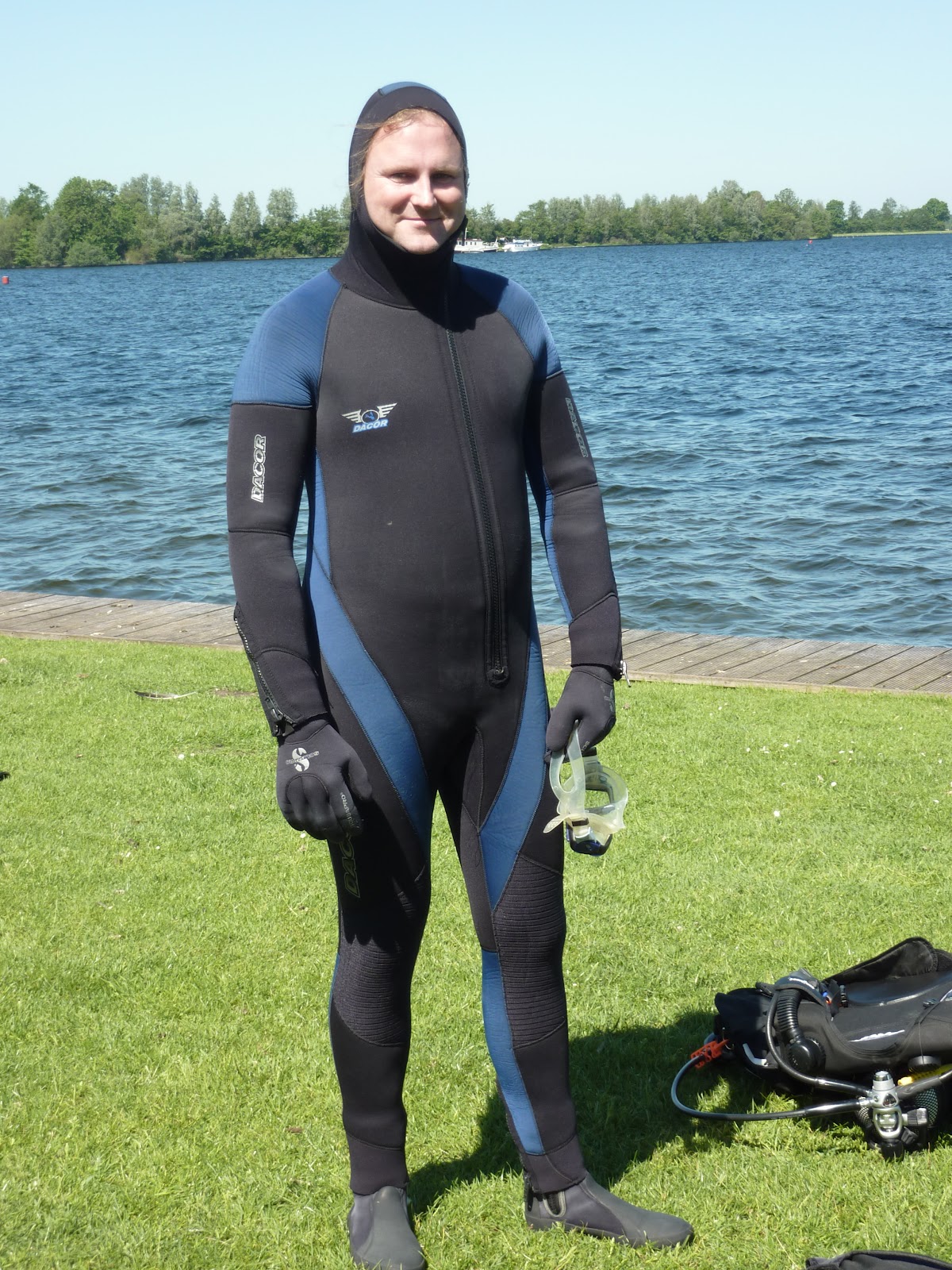
The majority of students in our MSc program on marine resource management is a diving fanatic. One of them, for instance, did an internship in Madagascar at Blue Ventures, an NGO that does research on the status and value of marine ecosystems in Madagascar and Belize and that offers volunteer work (i.e. to pay them to do work for them) to do dive surveys. Another student conducted a survey among divers in the Dutch Caribbean to estimate their willingness to pay for diving there. Diving is a major source of income of many marine conservation areas, especially coral reefs. So I figured I should at least know what it’s like underwater. Last weekend I did a discovery dive with Jacobs Diving in the Vinkeveense Plassen to experience just that. (OK, to be really honest, I figured it would make a nice birthday present for Monique, who told me before she would like to try diving.)

Photo taken by Jacob Van Velsen

The place we went to turned out to be a very popular place among Dutch divers, and it is not difficult to understand why: the water is exceptionally clear for Dutch standards and the presence of fish is so predictable that guide books show them on the map. (Seriously, it said: big fish here, and yes, they were real.) Jacob gave us short instructions of what we were going to do and then we went in. The first you notice is the heaviness of your own breathing: you suddenly feel like Darth Vader with bubbles. Everything else (the tinkling of the chains of a buoy, the breathing of other divers) is only slightly noticeable. As you hover through the sparse vegetation at about 2 meters deep you slowly see the rim approaching of a deeper area. Beyond that there is only dark, but as you go further you start making out shapes: a sunken boat, other divers. These diving places are full of objects to dive to, including a bus, a laundry carousel (complete with clothes), and one of those typical ANWB emergency telephones. The place wasn’t like a playground: it was a playground. There are even a couple of spring riders.

I can now understand what attracts my students in diving: in fact, I’m considering taking a PADI course myself. It’s a cliche, but there is a whole world down there and the experience is almost extraterrestrial. And this was just the Vinkeveense Plassen!

North Sea Foundation vs Climategate: my 2 cents

Last Monday was World Biodiversity Day, and the focus was this time on marine biodiversity. This means a lot of press releases and other broohaha (and boohoo) about declining marine biodiversity. I can point to plenty of problems with marine biodiversity (for instance, that delicious fish species like eel and southern bluefin tuna are at the brink of extinction), but you can read all about that here. For now, I want to look at the following statement by the Dutch North Sea Foundation (my translation; links added by me):

The North Sea, The Netherlands’ largest nature area, is under pressure. In 2010 the Nature Balance announced that only 40% is left of the North Sea’s biodiversity. “So it is necessary that important areas and animal species are well-protected, so that the sea’s biodiversity can recover”, says Monique van de Water of the North Sea Foundation.

Rypke Zeilmaker of Climategate disagrees because, among others, the Nature Balance figures are based on reference levels for which no scientific foundation exists (translated rather liberally):

As reference level for porpoises the Nature Balance uses an unfounded historical figure of 50,000 porpoises along the Dutch North Sea Coast and 1000 in the Wadden Sea. They don’t say why.

As I said before, I follow the Climategate blog not because I’m a climate sceptic (I’m not), but between all the accusations and rhetoric you occasionally find interesting viewpoints. So I looked up the documents on which all this is based. Here are a few quotes.

Osinga et al, 2007; cited in Wortelboer 2010, which is cited by the Nature Balance:
With a density of 0.390 porpoises per square km and a Dutch North Sea with a surface area of 57,000 square km the total number of porpoises in the Dutch North Sea is estimated at about 22,230 individuals.

Wortelboer 2010:
Based on the data of later analyses by SCANS II we estimated the number of porpoises at 11,000. (…) The Dutch Mammal Society (2007) estimates the current number of porpoises in the Dutch North Sea at roughly 17,000 (15,000 – 19,000) based on airplane surveys and SCANS II. (…) The Dutch Mammal Society estimates the porpoise population in the Dutch North Sea in 1950 at 32,500 (25,000 – 40,000) individuals. This is lower than the reference level according to Baptist and Jagtman (1997).

I don’t have the Dutch Mammal Society report but here is what Baptist and Jagtman (1997) say:

There are no measurements of porpoise populations before 1960. From the number of stranded animals we can say that the species was very common. (…) From biological monitoring studies we can deduce that there is a population of at least 30,000 individuals in the southern North Sea. This population was until recently present in the British part of the North Sea, but not in the Dutch part. Based on current knowledge the reference population can be estimated at more than 100,000 porpoises in the southern North Sea, of which 50,000 in the Dutch part of the North Sea.

Overestimated? Possibly. Shaky? Undoubtedly, but unavoidably in this kind of studies. Poorly referenced? I believe so: I would have liked to know what is meant by “current knowledge”. Unfounded? That’s too harsh. Scientific fraud, as Zeilmaker claims? Certainly not. There are simply no data, but the policy makers want figures to work with. And the affair after which the Climategate blog is named shows that if you don’t like the North Sea Foundation, PBL, or any organisation involved in environmental policy or research, it is always possible to find some mistake, misquote, omitted reference or whatever, and to blow that out of proportion.

But there is still something that bothers me about the 40% figure used by the North Sea Foundation. The indicator they use is a sort of average of a lot of other indicators, all of which express how well the environment is doing with respect to some reference level that is supposed to represent a pristine, untouched environment. So if the porpoise population would have been 50,000 in the absence of man, and it is now, say, 25,000, then the indicator for porpoises is 50%. There are loads of such indicators, and the method of aggregating them to a single figure can be debated at length also, of course. But that holds for any indicator that aims to express a multidimensional issue in a single figure (more on ecological footprinting in a later post).

No, what bothers me is that they also do this for commercial fish species like herring, plaice, and cod. Didn’t we agree under the Convention for Biodiversity that fish stocks should be maintained at Maximum Sustainable Yield? As a rule of thumb, a species’ MSY stock size is mostly about half what it would be in the absence of fishing, although for some species it can be as low as 25%. So if we meet our CBD targets and maximize the harvests we can maintain sustainably, environmentalists still have plenty to complain as these stocks have a “nature quality index” of 50% or less. So yes, please do take the 40% with a grain of salt.

A day on Urk

Fishing is not a big part of the Dutch economy: its gross added value is less than a percent of Dutch GDP. But it appeals to the Dutch psyche. One of the most iconic species in this respect is herring: the Dutch have a strange pride in eating it raw, holding it by its tail. One of the most important traded goods in the days of the Hanseatic League, it made some traders in towns like Deventer filthy rich. Alas, nowadays the herring fishery is dominated by the Norwegians.

But go to any market in a Dutch town and you will find a stall with the essential raw herring, kibbelingen (originally fried cod cheeks, but it can be any fish species nowadays – a lot of Dutch people think it’s a species of its own) or other seafood. And where better to eat your fish than at the Visserijdagen on Urk?

That’s right: on Urk – it’s a former island that is now a town in the Flevopolder. It’s a fascinating place. When the Dutch built the Afsluitdijk and the Zuiderzee became the IJssel Lake, the Urkers simply refused to go the same way as towns like Elburg and Spakenburg, where the old Zuiderzee fishery is no more than folklore. Instead, they moved their efforts to the North Sea and continue to have a thriving fishing community to this day. It’s by far the Netherlands’ biggest fishing community and auction, but most of the Urk fishing fleet lies more than an hour’s drive away in the Frisian town of Harlingen.

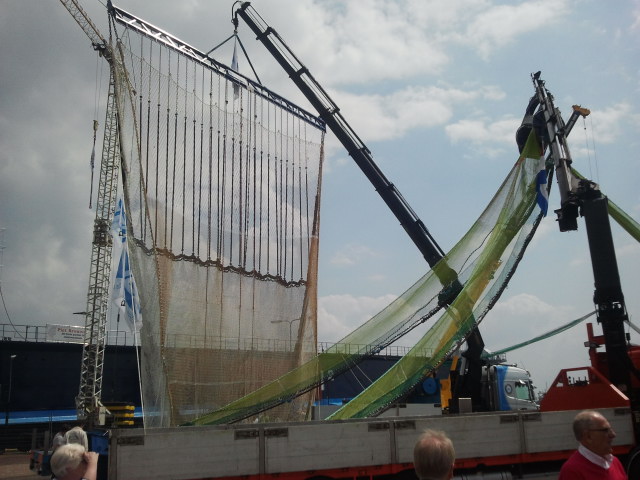
Like most of the Dutch fishing fleet, the Urk fishery is mostly focused on flatfish like plaice and sole, which they catch by bottom trawlers. As far as I can judge these species are fairly well-managed, although the sector has its share of problems including high fuel prices and growing criticism from environmental organisations at the impact of fishing on the benthic ecosystem. The fuel use and benthic impact go hand in hand: so far the most widely used fishing gear is the beam trawl, which is a fairly heavy piece of equipment that includes so-called tickler chains to stir up the flatfish. It takes a lot of energy to drive the beam trawl over the sea bottom, and biologists argue that it also affects many other species. Therefore, fishers and researchers are currently doing a lot of technical research on alternative gear with lower fuel use and benthic impact. One of these is the pulse trawl, which sends light electrical pulses that have the same effect as the tickler chains on flatfish, but have a much smaller impact on the sea bottom. They had one of those displayed in the harbour.

A day like this attracts a lot of people, and I’m sure the weather helped. Or maybe it was the free bag of fish: this is The Netherlands, after all.

WWF’s Living Planet Report

WWF has a new edition of its Living Planet Report out. I promise to read it more carefully in the near future, but what bothers me about it already is their use of the ecological footprint to make their case. Economists have long criticized the use of the EF as a measure of sustainability. I’ll get deeper into the reasons for that in future posts, but the bottom line for me is that it is often interpreted in a normative sense, even though it cannot be used for that purpose. In other words: it only tells you, in a simplified way, whether we can keep up our current way of life, but it says nothing about the consequences of living unsustainable. Therefore, you risk sounding the wrong alarm bells. By the same token, the way it is designed it is strongly biased against cities and trade: two things economists like and ecologists dislike. This goes some way in explaining its popularity but that does not mean it is an accurate indicator.

Anyway, I’ll go deeper into this later.

Edited 13 June 2012: Changed the title. I should have known about the kind of connotations animal limbs can have (pandas, camels). That’s what you get when you’re not a native speaker.

Religion, academics, and fisheries policy

I once explained to a non-Dutch economist how religion affects Dutch fisheries policy and she could hardly believe me. Here is a post from a fisherman from Urk, The Netherlands’ biggest fishing community, that perfectly illustrates how deep this impact goes, and how it complicates fisheries policy.

If you can’t read Dutch, let me translate the gist of the piece (hyperlinks added for clarification):

Last Monday we were fishing on the East side of the Cleaver Bank. This is one of the areas our green friends of Greenpeace claim is an important nature reserve, making their point by dumping a bunch of stones. Catches were great until the wind turned and our catch suddenly reduced to about half of what we were catching. I’ve seen this happening before, and I used to ask older fishers: “The fish has to be somewhere, right? It can’t just disappear, can it?” And all they could answer was that they just did not know. It makes you wonder who we think we are to think we can exert any influence on the fish. You won’t convince me that we, with our small boats, are capable of destroying the entire sea bottom as so many folks say we do.

Nature is so great, it does not care about what we do, it goes its own way and the way planned by its Creator. Man’s activities could change that a bit on the short term but it will not establish real change. There is fish, or there is no fish, but where it comes from or where it goes nobody knows. There have been bad times and there have been good times. You can’t express it in some graph that needs to be interpreted so that some policy can be implemented. You can’t confine Nature in little boxes such as the Plaice Box. It is impossible to understand Nature, and more difficult to predict than the weather.

We can do our job every week in that Creation, to enjoy its diversity, to which we sometimes pay too little attention. Our sights are obscured by our everyday financial troubles but all the while we can enjoy the greatest masterpiece of all times, God’s Nature.

We can run all the models we like, do all the estimations we like, but any attempt to limit catch or fishing effort will at best be grudgingly accepted by somebody with this world view.

So who’s right? I’m tempted to side with the biologists and to say they should try better at convincing the fishers, but I won’t, for two reasons. First, I find that a paternalist approach that can only antagonize people, and one of things most lacking in fisheries policy is mutual trust. Second, even the biologists themselves admit they don’t know everything so I think a two-way communication would be much more helpful. Yes, we might learn a thing or two from the fishers.

Fisheries policy has all the ingredients of a policy maker’s nightmare. Like climate policy, fisheries management is dazzlingly complex, with a lot of unknowns. The Plaice Box was established to protect juvenile plaice, thereby improving the entire flatfish fisheries. The fishers hated it and did not expect any good from it. Ever since its establishment, its stocks of juvenile plaice have declined! The biologists are still in the dark why, but the fishers feel vindicated.

Moreover, there is a huge gap in world view and education between the sector (religious, vocational training) and the researchers (secular, PhD). I know of nobody who ever crossed that rift. In Wageningen you meet many academics who come from a non-academic background: many of my colleagues and students were born and raised on a farm, and I myself was born right above my father’s butchery. I think a lot of agricultural policy would not have been possible without people who knew both worlds. But I have never met any student in, say, animal husbandry, biology, or marine resource management whose father went out on a fishing vessel every week.

Lastly, there are institutional problems, and history has not been helpful here. Fish stocks have been a free-for-all for centuries, with all the known commons problems, but also establishing a sense of entitlement among fishers. It is their fish, it is their fishing area. Sadly, the moral entitlement has not been joined by a legal one: a farmer may own land, but a fisher has no legal tenure over any area in the North Sea. So legally the government can designate huge no-take zones without having to compensate anybody, but doing that on land involves huge costs in buying land or compensating people.

Man, I love my job (had a nice raw herring with onions yesterday).