Bitung: Plight of the baby tuna

Meet you on the corner of skipjack street and yellowfin street

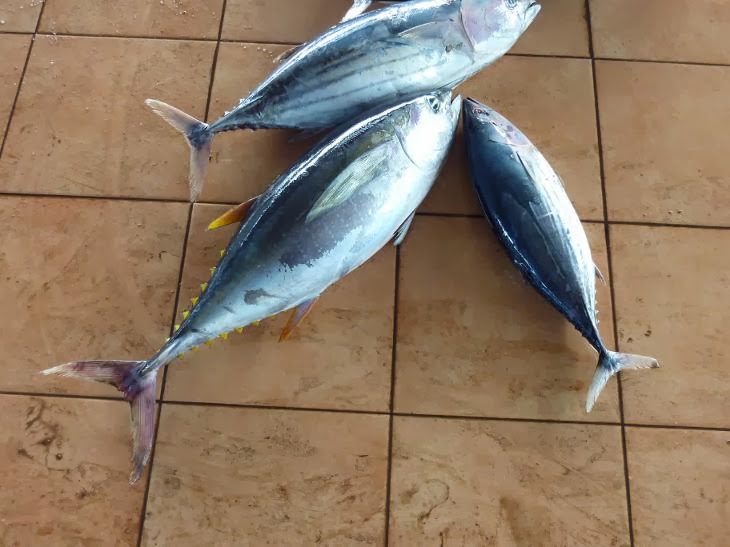
Recent news announced that Indonesia will become a full member of the Western and Central Pacific Fisheries Commission, instead of a cooperating non-member as it has been so far. This is good news, because the country is an important player in the Western and Central Pacific tuna fishery. Indonesia caught more than 900,000 tons of tuna in 2010, about a third of which was skipjack (cakalang, as the Indonesians call it), and another substantial share is yellowfin (madidihang), bigeye, and other species. What’s more, Indonesia and the Philippines are known to catch a large number of juvenile tuna:

Number of yellowfin tuna caught (vertical axis) by 2-cm size class (horizontal axis) in 2012. Blue colours indicate tuna caught by purse seines; yellow indicates tuna caught by fisheries in Indonesia and the Philippines. Yellowfin matures by about 100 cm. Source: Williams, P. and Terawasi, P. 2013. Overview of tuna fisheries in the Western and Central Pacific Ocean, including economic conditions. WCPFC Scientific Commission, Ninth Regular Session.

You can use juvenile tuna as bait, consume it yourself, or sell it. But each juvenile tuna you don’t catch may become an adult. This adult tuna would then produce more tuna. It might also fetch a higher market price, especially if it is yellowfin tuna. Granted, it may also be caught in Pacific areas outside Indonesia. In that case Indonesia would not benefit from this one juvenile tuna it leaves in the ocean, although other countries would. So the catch of juvenile tuna is one of the issues WCPFC would like Indonesia to address.

Shinta in action on a handline vessel

Shinta Yuniarta, one of our PhD candidates on BESTTuna, is currently trying to estimate the magnitude of the catch of juvenile tuna (or baby tuna, as the Indonesian fishers call it) through a survey in such ports as Bitung and Ambon. I visited Shinta last week in Bitung to learn as much as I could about the situation on the ground, and to work with her in further sharpening the survey questions and the rest of her research. It was one of those trips that stay with you long after you have boarded the airplane back home.

Everything in Bitung says “fish”. And very often, it actually says “tuna”. The hotel even smelled of fish when I arrived. It sports a picture of a bigeye tuna right above the breakfast buffet. Small eateries (warung makan as the Indonesians call them) offer pieces of yellowfin tuna in a spicy sauce, or delicious coral fish roasted on a charcoal fire. Everywhere you look there are huge fish processing plants, canneries, or fishing companies that have their own fishing wharf. The small-scale fishers land their fish at the central landing place in the port. Originally it was meant to be an auction, but for some reason the auction never really got off the ground, so fishers sell their fish directly to traders who bring the fish to local markets or to processing companies.

As far as I could see the small-scale fleet featured three main types of fishing. The most common seemed to be the handline fishery, where fishers use a single line with some bait on a hook to catch the tuna. Another important fishery is the pole-and-line fishery, where bait is simply thrown into the water (and water is also sprayed on the surface) to get the tuna into a feeding frenzy, so that it will bite anything that comes along. Fishers then only have to throw in a hook and the tuna will bite; these vessels are usually larger than the handline vessels, and employ a lot of crew. The third common method turned out to be the pajeko, or small purse seine, but this method was mainly used to catch not tuna, but small pelagic species such as anchovies and Indian Mackerel.

Special offer: room with a view in Sulawesi. Water and food not included

In all cases the Fish Aggregation Device (FAD), or rumpon as the Indonesians call it, is important. It’s an interesting system. Before I came I was wondering: when you make a FAD and place it in the sea, how do you make sure that it is used by nobody else but you? The solution turned out to be simple: you put a guard on it. Yes, every rumpon has somebody guarding it 24 hours a day. This guy lives in the small hut built on top of it, with probably some sort of radio communication, and makes sure that nobody but the owner catches the fish gathered under it unless the owner is paid a comfortable sum of money. The rumpon guard also informs the owner or his vessels of the amount of fish under it, so they won’t waste their time coming to a rumpon with no fish under it.
So what did we learn so far? First, a lot of fishers readily admit that they catch a fair amount of baby tuna. They use it as bait, consume it on board, or take it home to their families. It is not illegal to catch juvenile tuna, so they seem willing to tell us how much they usually catch. And although the weight of baby tuna may be small, the number of baby tuna caught, and the fact that each baby tuna could have become a big, valuable tuna makes that the catch of baby tuna can still be a serious problem. Second, the catch of baby tuna is by far not the only unknown in the Indonesian tuna fishery. There may be unreported or even illegal catch. Some authors argue that Indonesian ports lack sufficient staff to check the accuracy of logbook data. Third, although it was fairly easy to contact and survey small-scale fishers, it turns out to be a lot more difficult to contact large-scale fishing companies.

But perhaps the most important lesson was the reminder that “small-scale” does not necessarily mean “sustainable” or “green”. The idea of small-scale fishers tends to conjure up the idyllic images of hardy, honest folk that you see on Discovery Channel, read about in stories like Hemingway’s The Old Man And The Sea, or hear about in songs like The McCalmans’ “Five O’Clock In The Morning”. No doubt that the people we spoke to in Bitung are honest, hard-working people who must endure many hardships to scramble a meagre income for themselves and the family they support. But a lot of fishers and consumers may benefit greatly if less baby tuna were caught. It’s a difficult dilemma: a lot of very poor people depend on a fishing method that might disadvantage a lot of others.

What is this researcher afraid of?

A thoughtful article in the Dutch newspaper De Volkskrant of 25 September 2013 deals with publishing in Science and Nature and cites a researcher who wishes to remain anonymous:

We try every now and again to get in the top journals, because Science or Nature look good on your cv (…) But it’s nonsense. My two most important articles (…) were not even considered by Science or Nature. On the other hand: I once had a Nature publication on what was absolutely the worst experiment I ever did. But that was on a hot and photogenic topic. (…) What matters to the editing boards of those journals is to keep up the status of the journal, by keeping up their impact factor. This automatically leads to a preference for fields and articles that will be cited a lot. (…) The result is also that editors have less expertise in less popular disciplines, and they have failed recently in that respect.

This is very similar to Ray Hilborn’s complaints about the quality of these two journals. But then, why does this researcher want to remain anonymous? What is he or she afraid of? Being sued or ostracized by Nature and Science editors? (If he or she has reason to be afraid, why am I putting this on my blog? Oh wait…)

My impressions of the 2013 ICES Annual Science Conference

My impressions after a week of presentations, discussions, and lots of delicious food:

  • Of all the interdisciplinary conferences I’ve been to so far, the ICES meeting was the most scientific (read: least political, notwithstanding ICES’s role as advisory body for fisheries policy), and the most constructive in its interaction with social scientists (read: economists). Besides EAERE (which I consider a disciplinary meeting) I was once at an ESEE meeting, and once at the European Congress for Conservation Biology. I had mixed feelings about those for their tendency to bash “mainstream economics” (whatever that may be) and to blur the line between science and activism. Perhaps it’s because those communities have the hidden assumption that nature is best left alone by man, whereas fisheries scientists investigate, by definition, a form of interference in nature.
  • Is it just me, or is there a major disconnect between textbook fisheries economics and the practice of fisheries management? Concepts we teach (notably maximum economic yield and the role of the discount rate) are nowhere to be seen – in fact, I once heard a fisheries industry representative refer to maximum economic yield as “a plaything for economists”. In our teaching we hardly pay attention to the stochastic nature of fish stocks, but these days fisheries science is all about reference points and harvest control rules – which only make sense in a stochastic context.
  • Economists can make big contributions to fisheries management by further strengthening how fisheries models describe human behaviour. So far those contributions were largely confined to modelling where fishers fish, but what about investments in gear, or boats? Let alone market structures, global developments (tilapia!), value chains, and policy-makers.
  • Iceland is like an extreme version of Norway. Thought the Norwegian landscape was rugged? Iceland has volcanoes, and geysers! And where I thought Norwegians don’t give a hoot what the rest of the world thinks of hunting and whaling, only Icelanders can serve raw whale meat and rotten shark to a crowd of foreign scientists. (And it was delicious! The whale, that is.) Neither do Icelandic pubs have qualms with playing the entire Velvet Underground & Nico, including John Cale’s ear-piercing viola solo in Heroin.

Are humans like fish?

This spaceship currently hosts about 700 fisheries scientists attending the Annual Science Conference of ICES. ICES is an international body that assembles stock assessments and other results from fisheries research in Northern Europe, Canada, and the United States. Fisheries scientists use a lot of detailed models of the marine ecosystem, which allows them (up to a point) to project how different policies affect such things as fish stocks, catches, and so on. I also entered the vessel (more accurately the Harpa conference center and concert hall in Reykjavik, Iceland) to discuss how such models can take the human factor into account. After all, humans take part in the marine ecosystem (in many cases we are the top predator), but we also develop policies with the interests of humans in mind. So if we can model fish, why not also model humans?

“It can’t be done”
A common objection against this is that human behaviour cannot be modelled. Of course, as a model-building economist I don’t agree with that. Economists have a large set of quantitative models at their disposal that describe human behaviour at several different spatial scales, from consumer choices to entire economies or even international trade. Some biologists at the meeting explained that similar objections were made when biologists started developing their own ecosystem models, but that has never stopped such models from proliferating. Why would humans be any different? The discussion set me thinking about the similarities and differences between humans and fish, and how they could make modelling human behaviour easier or more difficult than modelling animal behaviour or ecosystems.

Why humans are like fish
Basically we discussed three objections that were made against biological models, and are now made against modelling humans. First, people object that the object of the model is too complex. That’s true, but so are the global climate, the cascade of nuclear fission and fusion in a hydrogen bomb, and a horde of blood-thirsty zombies climbing over a 50 meter high wall. But that never stopped people from modelling these processes in a plausible manner (admittedly, one of these examples is fictional and no, it’s not the first one). If we don’t model these processes we will never understand them or how they interact with other processes.

In the fish tank

A second objection is that the processes are uncertain. But although uncertainty complicates matters, it can be dealt with. You can do a sensitivity analysis to assess the robustness of your results. There are methods to optimize uncertain systems, such as stochastic dynamic programming models or uncertainty analysis. Such steps are necessary, they can be difficult, but that is no reason not to try.

A third objection is that models tend to induce tunnel view, where effects that are not “in the model” are ignored. This is a fair point, and as an economist I must admit that my profession has not been immune to this effect. So we need a diverse ecosystem of theories, approaches, and models, in order to stay open-minded for arguments or effects we hadn’t thought of. Again, this objection has also been made with respect to biological models, and it has never stopped biologists from modelling.

Why humans are not like fish
This is where it gets interesting. First of all, fish don’t read. People, however, may read your report and respond. There is evidence that negative news coverage on consumer confidence further reduces that same consumer confidence. This is a typical feature of social science research: as a researcher you have an impact on your object of research (i.e. people) that goes much deeper than any quantum physicist could get. Your results could be self-fulfilling, as in the consumer confidence case. They could also be self-defeating, as some people argued was the case with Limits To Growth: the stir caused by this report inspired efforts to reduce pollution and resource use to such an extent that we evaded the environmental catastrophe predicted by the report. (I’m not sure I’m buying the argument about this particular example but you get the idea.)

Second, I would argue that humans are much better at anticipating what other humans, including governments, do. For example, a common objection against vessel buybacks is that they create an expectation among fishers that the government will buy access capital (at tax-payers’ expense) when the going gets tough for fishers – an open invitation for creating excess capacity because fishers face only part of the financial risks. Likewise, fishers may anticipate what other fishers do in their decision whether to fish, and how much to fish.

Who needs a window if you can have a view on virtual nature?

Third, many properties of humans, such as customs, habits, and technologies, are much more subject to change than those of animals. Over the 200,000 years of its existence, homo sapiens has developed sticks, houses, wheels, fish nets, purse seines, and pulse trawls. We’re the only animal with such a massive change in capability and impact. And although economists commonly assume that preferences don’t change over time, I’m not so sure. Suppose we estimate the recreational value of a natural park to be, say, €5 million, will it remain like that forever? There was a time when forests were for cutting down – they were seen as collecting grounds of villains and predators. Now we want to protect them out of love of exercise, hunting, and nature. What if our descendants develop a taste for hikes in virtual reality (or simply get glued to their iPads), and hikes in real forests fall out of fashion?

Fourth, on the bright side, we cannot communicate with fish but in social research we can do surveys and interviews to gain insight into their considerations, their lines of reasoning, and so on. These methods are not perfect (people can lie, or withhold information), but neither are biological measurement tools such as the ones used in stock assessments.

Should we? Can we? How?
The bottom line is that we can to some extent model human behaviour, and by doing so we can address a lot of pressing problems. But it will be tricky. I can’t judge whether it will be trickier than modelling fish, but it will surely be tricky in different ways. Again, that should not be an impairment to doing it.

Confusing Nemo (3): Enjoy your fish in 2049

Next in my little fact-checking exercise of The Black Fish’s movie Losing Nemo:

If the fishing industry keeps fishing at its current rate, science predicts that all fish will be gone by 2048

This statement is based on a paper in Science (see a copy of the article here) by marine scientist Boris Worm, published in November 2006. Intriguingly, the objective of the article is not to predict anything like stock collapse: rather, it investigates the importance of biodiversity for the provision of a host of marine ecosystem services, such as fisheries, nursing juveniles of marine species, and filtering of waste from human sources. The article finds a crude but nevertheless convincing positive correlation between species richness and such traits as productivity and speed of recovery from overfishing: in other words, species-rich ecosystems produce more biomass than species-poor ecosystems, and also recover more easily from overexploitation. So is that where the 2048 prediction comes from, a projection of biodiversity decline that should lead to worldwide stock collapse around 2048?

Actually not. One of the driving forces considered in the article is fishing pressure, so it describes how more and more fish stocks have collapsed (defined as catches dropping below 10% of the highest catch ever recorded) since 1950, according to data from the Sea Around Us project. Based on these data the authors estimate a mathematical formula to describe this trend:

y = 0.0168*x1.8992

where y denotes the percentage of fish species currently collapsed and x denotes the number of years after 1950. Later in the article the authors make the following remark:

This trend is of serious concern because it projects the global collapse of all taxa currently fished by the mid–21st century (based on the extrapolation of regression in Fig. 3A to 100% in the year 2048).

2048 is 98 years after 1950: indeed, 0.0168*981.8992 is about 101.

The perils of extrapolation
So that’s where the 2048 comes from. A trend, based on data over about 50 years, extrapolated another 50 years until we reach 100 percent. This claim, and how the authors arrived at it, has attracted a lot of criticism, which I won’t discuss in detail here, but in my view the most fundamental objection is that extrapolating any trend, especially an exponential trend describing a number with a natural maximum (like a percentage), by as far as twice the observed range is bound to give extreme and unrealistic outcomes. In this particular case, as more and more stocks ‘collapse’, you are bound to have stocks left that are actually quite well-managed. Most Atlantic pelagic stocks, such as herring and mackerel, are healthy and well-managed. Not only are the stocks large enough to ensure plenty of replenishment that compensates fishing mortality, the institutions to manage the fishery, like Exclusive Economic Zones, scientists doing stock assessments, and stringent government policies, are also in place. North Sea herring is MSC certified. Iceland has practically its own national cod stock which it would be crazy to deplete. A lot of overfishing is due to poor exclusivity of stocks and the ensuing Prisoner’s Dilemma, but these institutional flaws are largely absent for most North Atlantic stocks. And this is just one example.

How a side remark came to define a paper
If the 2048 estimate is so shaky, why do the authors make this claim? Remember that the objective of the article has never been to predict fisheries collapse: the authors wanted to assess the importance of species richness for marine ecosystem services. The 2048 claim was a side remark that ended up as a red flag in the associated press release. Interestingly, in the same month the 2048 article was published, the American fisheries scientist Ray Hilborn complained in the American magazine Fisheries (see a copy of the article here) that more and more articles in marine science, especially in leading journals such as Nature and Science, were published not for their scientific merit but for the public impact of their press release:

These four examples [not including the 2048 article, RG] illustrate a failure of the peer review system and lack of the basic skepticism needed in science, and are unfortunately but a few of the many papers now appearing with similar sensational but unsubstantiated headlines. […] Critical peer review has been replaced by faith-based support for ideas and too many scientists have become advocates.

Indeed, Worm’s paper was accompanied by a press release running the secondary headline “Current trends project collapse of currently fished seafoods by 2050”. Apparently, the headline was meant as a wake-up call:

In a note to colleagues that was mistakenly sent to The Seattle Times, Worm wrote that the projection could act as a “news hook to get people’s attention.” “One reason why nobody cares about marine biodiversity is that there seemed no clear end in sight,” he continued. “… Well, it’s time to wake up — IF the current trend continues we will see drastic consequences in our own lifetime.” (Excerpt from The Seattle Times)

Trevor Branch recently published a very insightful analysis of how the article was received in the scientific community. He found that among the articles citing the Worm et al. paper, the ones referring to the 2048 claim “had characteristics that suggest unfamiliarity with the controversy surrounding this projection, namely papers with few authors, published in journals with low impact factors, in fields far removed from ecology and fisheries, and sharing no coauthors with the Worm et al. paper.” In other words: it’s the rebels without a clue who cite the article for its doomsyear 2048.

The usual disclaimer
I’m no environmental Pangloss. There is plenty to be worried about, like the criminally exploited bluefin tuna stocks, or the continuous decline of European eel. Institutional problems abound in many regions of the world, making it exceedingly difficult to implement a sustainable system of stock management. And then there are pressures like ocean acidification, proliferation of invasive species, accumulation of plastics, and so on.

But I also believe that activist science will eventually eat itself. If a scientist bases his claims on wild extrapolations such as these, he or she is making it the pseudo-skeptics just too easy.

Lava, limpets, and lotsa fresh fish

What I did last Summer: spent two weeks on the Azores.

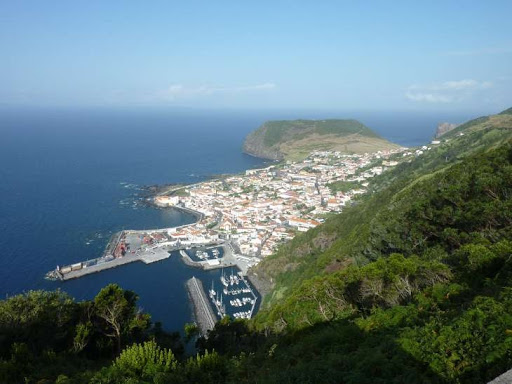
Why The Azores? Because they have the perfect climate for a summer holiday (a steady 25 degrees), lots of hiking trails, plenty of fresh seafood, many small natural swimming pools, and great opportunities for spotting whales and dolphins. And I was fascinated by this Portuguese outpost almost in the middle of the Atlantic Ocean, where locals still caught sperm whales in the 1980s with small rowing boats, and where the ocean is a natural part of the landscape.
It’s magnificent. All nine islands originated from volcanic activity, the remnants of which are visible in the form of dead volcanoes in the landscape. Settlements are crammed between the steep slopes of the volcanoes on one side and the ocean on the other side, often on what the Azoreans call fajas: small areas of flat land, often consisting of rubble from collapsed rocks. On one side the volcanoes, which used to spew fire and sulfur but are now covered in sinister dark boulders of basalt; on the other side the ocean, thriving with life but also unpredictable and dangerous. You can truly say the Azoreans live between the devil and the deep blue sea.
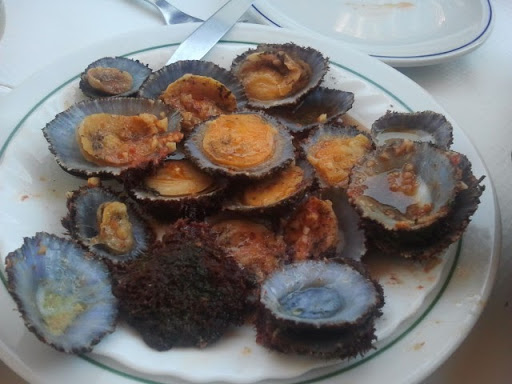
A taste of local marine biodiversity:
grilled limpets on the island of Sao Jorge
Before you go, read Moby Dick. The American sperm whale fishery of the nineteenth century, so vividly described by Herman Melville, brought whaling to The Azores. Until the Azoreans abandoned whaling in 1983, their method of whaling was very similar to the method described in the book. The Azorean whalers approached the whale in small rowing boats, from which they drove a harpoon into the sperm whale’s body. In panic the whale would quickly dive to escape his attackers, who, by means of the rope attached to the harpoon, would be able to track the whale’s location. When the whale resurfaced, the whalers would further wound the whale until it succumbed. Catching one whale could take a dangerous and blood-drenched struggle of several hours.
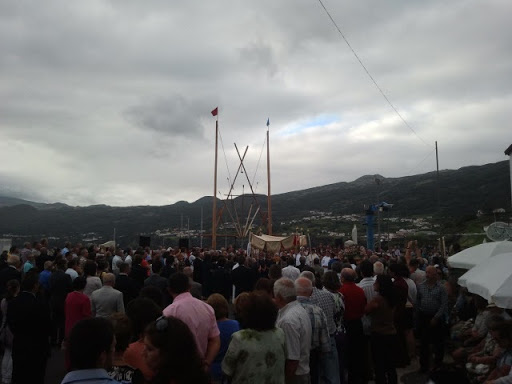
I admit it must have been the most gruesome way of killing an animal, and I’m sure few visitors mourn its demise. But for the Azoreans, especially the people from whaling towns like Lajes do Pico, it was a valuable tradition and a source of pride. We were so lucky to arrive on Pico in the middle of its Whalers Week. Lajes do Pico features two whaling museums, a few whale watching companies, and a small fleet of traditional whaling boats. During the Semana Dos Baleeiros, as the week is called in Portuguese, the people of Pico honor Our Lady of Lourdes, the whalers’ patroness saint. The week is a mix of live music (lots of brass bands), folkloric and religious processions, and lots of food (fish, fish, and some meat) and drink (we stuck to the caipirinhas).

The whaling industry has disappeared, not because of animal welfare concerns or because they ran out of sperm whales, but because the products from whaling (oils, fats, proteins, with many applications in cosmetics, agriculture and industry) got more and more competition from cheaper synthetic alternatives. But no more than three years after the local whale oil factory closed down, the first whale watching company emerged. Nowadays a complete industry has evolved in whale watching, swimming with dolphins, diving with sharks, and so on. I’m not sure I agree with all of it, but in any case we enjoyed seeing real-life sperm whales (their flukes, at least). As regards the dolphins, if you’re lucky you only have to take the ferry to spot them:

The Azores have a small-scale tuna fishery that catches mainly skipjack tuna by pole-and-line. The islands have their own brands, certified with the Friend of the Sea label, and they export most of it to Italy where their particular brand is much preferred. We didn’t get to see much of the fishery but we could see the vessels in many of the harbors we passed.

And that, I must say, was perhaps the main treat of the place: fresh fish, fresh seafood, everywhere you go. Species you never heard of but that taste deliciously. A waiter warning you that the fish is not fresh but frozen (the only Dutch restaurants not serving fish from the deep-freeze are vegetarian restaurants). And all that washed down with some delicious Pico wine or mainland vinho verde.

Back to work.

Confusing Nemo (2): Fisheries subsidies, good and bad

Next in my little fact-checking exercise of The Black Fish’s campaign movie:

“Every year, $25,000,000,000 of tax money continues to subsidize a very harmful industry”

And that’s a literal quote from the movie. The implication is clear: our tax money – $25 billion of it – is being spent on promoting overfishing. Where does the figure come from?

Rashid Sumaila is a Canadian resource economist who has gained a big reputation with his work on game theoretic analyses of fisheries and big, global-scale analyses of fisheries subsidies. If anyone knows about the global scope of fisheries subsidies it is him; the $25 billion in The Black Fish’s movie is based on his 2010 article in the Journal of Bioeconomics.

Interestingly, the article does not only give an estimate of the total amount of subsidies, but also distinguishes three types of subsidies: beneficial subsidies, capacity-enhancing subsidies, and ambiguous subsidies. The distinction is based on what the subsidy does to the resource stock: does it lead to bigger (beneficial) or smaller (capacity-enhancing) fish stocks? This criterion is fairly easy to apply and interpret, but it also leaves some issues out of the discussion, as we will see later.

Beneficial subsidies

Beneficial subsidies contribute to the resource stock, and include such expenses as monitoring programmes, research for stock assessments, and establishing MPAs. Their total amount is about $8 bln.

The article does not ask the question whether this should all be funded by tax money. The rule of thumb should be: subsidize public goods, but let the users of the public good pay whenever possible. As a fish consumer I’m willing to contribute (through a higher fish price, ideally) to a responsible management of our fish stocks, but I’m not sure I agree with sending the bill to those who have no stake in it, like vegetarians (or principled meat eaters, for that matter). The exception may be MPAs, which provide more public goods than just more fish (which is not as clear-cut as it seems, by the way).

Capacity-enhancing

This includes tax-payers’ money spent on enhancing fishers’ capacity to deplete fish stocks, like public money spent on port development, fleet renewal, and price support. With $16.2 bln this is the largest category. By far the largest type of capacity-enhancing subsidy (or any kind of fishery subsidy) are fuel subsidies: every year a whopping $6.4 bln is spent to lower the price fishers pay for their fuel. Sumaila et al.’s definition of fuel subsidies is interesting: they define fuel subsidies as the difference between what fishers pay for their fuel and what other sectors pay for the same fuel. This means that (partial) tax exemptions, like the red diesel that The Netherlands until recently had, are included; however, blanket fuel subsidies, like those in Indonesia, Nigeria, and Egypt, are not.

I don’t know how the authors categorize subsidies for more selective, or low-impact fishing gear, such as the pulse trawl. It must have been difficult to identify exactly on what kind of innovation or renewal a subsidiy is spent, so I suspect the authors have filed this as capacity-enhancing.

You could also argue that port development is simply an investment in infrastructure, which is a public good. The government also builds roads, railways, and glass fiber networks, why single out port infrastructure as a subsidy to fisheries? Moreover, is port development bad if fish stocks are healthy and well-managed?

Ambiguous subsidies

For researchers this is the most interesting category because its effect is unclear. Buyback subsidies, for example, may reduce fishing capacity on the short term, but on the long term the effect is less clear-cut. The vessels bought may go to other countries at dumping prices; fishers may also anticipate future buybacks when deciding whether or not to invest in new fishing capacity. Ambiguous subsidies amount to about $3 bln.

Do tax-payers spend $25 bln on overfishing?

Now I’m confused. $8 bln + $16.2 bln + $3 bln = $27.2 bln, not $25 bln as the movie states. The article’s abstract, however, estimates the global amount of subsidies at between $25 bln and $29 bln. Does The Black Fish prefer to give a conservative estimate, rather than the best estimate according to the article? But then why lump together scientific research and establishing MPAs (which I cannot believe The Black Fish would oppose) with fuel subsidies (which are undoubtedly wrong)?

Weird music, ditto beer

Call me a snob, but I’ve never cared much for the music you hear on everyday radio. I don’t know what it is. I prefer the grinding doom of Ufomammut and the richness and purity of a skilled traditional fiddler to the polished one-size-fits-all music mostly served on prime time. So while around 80,000 pop music lovers were sweating away in a simmering Rock Werchter, I was one of the 5,000 folk music lovers enjoying the atmosphere, the music, and the local lambic beer at the Gooikoorts festival.

I discovered traditional music (like many of my generation) through The Pogues. While attending college I spent four months in Ireland, going after the local folk music with my guitar and buying a cheap and crappy mandolin. Years later the Saint Chartier festival was a revelation to me: all those musicians, all those dancers, all those instrument makers, in such a small village! As soon as I came home I hung the mandolin on a wall and bought a fiddle. The fiddle’s been with me ever since. Slowly the Saint Chartier festival gave way to Gooikoorts, which feels like a much smaller and friendlier version of Saint Chartier with even a higher degree of joie de vivre. In Dutch I would call it “Burgundian”, a term that refers to the days when present-day Belgium, Luxemburg, and The Netherlands were part of the Duchy of Burgundy, but also to the stereotype of a people that loves the good life.

Gooik is a small village (about 9,000 inhabitants) in the Pajottenland, southwest of Brussels. The region is famous for its mattetaarten (cakes made from cream and buttermilk), but even more famous are its unique beers. Unlike most beers, where carefully selected yeasts convert the sugars to alcohol, geuze and lambic get their fermentation bugs from the open sky. The beers are an acquired taste: deeply sour, and in the case of lambic not a single bubble of carbonate. But once you get used to the sourness you start appreciating the tones of apple and oak not found in any other beer. Many brewers from other regions, from West-Flanders to the United States of America, have tried to imitate the process by taking samples from the Pajottenland air, but so far they haven’t been able to beat the real thing. You need the right mix of micro-organisms, especially Brettanomyces bruxellensis, which is a bacterium unique to the region. Real geuze and lambic can only be brewed in the Pajottenland, and nowhere else.

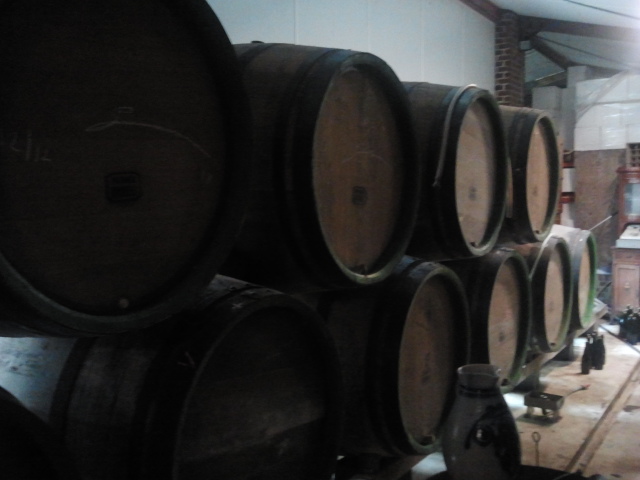
Since 1997 Gooik has its own geuzestekerij. “Steken” is a local term for blending, so a stekerij is a place where geuze is matured and blended, but not brewed – they get the wort from other breweries and mature and blend it in Gooik. I finally had the opportunity to visit the geuzestekerij and buy some bottles of the stuff. The place is crammed with 200-year old oak casks where the beer matures, soaking in the oak flavour as well as more germs. The beer matures for 3-6 years (“1 bottle = 3 years work”, the label says) and is then blended to oude geuze or mixed with fruit. What struck me was the dedication to tradition of the people working in the stekerij, but also its international appeal. Just when I entered the building there was a delegation from Brazil tasting the local brew.

The local brew and the excellent food are just two of the many factors that add to Gooikoorts’ Burgundian atmosphere. The bands play mainly traditional European folk, varying from strictly traditional Flemish folk songs, to jazzy interpretations of French dance music, to mixtures of Finnish polka and bluegrass. All generations are present: young parents with toddlers in their arms, teens with hormone-driven chutzpah, pensioners with an open mind. For me, the greatest enjoyment was to meet old friends, and to grab the fiddle and play. Ten years ago, at the first edition of the festival, we would play until the sun rose, sleep a few hours, and party on. Now most of us had kids, a demanding working life, or both, so we took it easy. And easy is how you take Gooikoorts.

Have a great summer.

Confusing Nemo (1): How much is too much?

The Black Fish, an environmental NGO, has made an animation movie on fisheries. Laudibly, the organisation provides the sources for its (albeit not all) claims. I agree with some statements they make, but not all. Let me go through some of them one by one in a series of posts. Number one:

“The global fishing fleet hauls in 80 million tonnes of sea food”

The latest FAO report on the State of the World’s Fisheries and Aquaculture (SOFIA) on this states that the amount of fish captured in marine areas is indeed around 80 million tonnes each year. I suspect, however, that this only includes the recorded landings: figures on discards and illegal landings are probably too shaky to be included in these figures. So catches might actually be higher.

So the 80 million tonnes seems accurate, but is it much? For comparison: FAOSTAT states that the world produced almost 300 million tonnes of meat in 2011. But that says little about whether 80 million tonnes (or perhaps more, due to discards and illegal landings) is too much. The most widely used benchmark for this is maximum sustainable yield (MSY). The SOFIA does that, and concludes that around half of evaluated stocks is fully exploited (around MSY); overexploited stocks (stocks that, in the report’s definition, “produce lower yields than their biological and ecological potential”, due to low stock abundance) make up about 30% of the stocks evaluated. Of the remaining 20% harvests can be increased sustainably. What the report also says is that

The declining global catch over the last few years together with the increased percentage of overexploited fish stocks and the decreased proportion of non-fully exploited species around the world convey a strong message – the state of world marine fisheries is worsening and has had a negative impact on fishery production.

In other words, the fact that slowly the number of overexploited stocks is increasing while catches stabilize or decline should, according to the FAO, be taken as a bad sign.

If you want a second opinion, this article by Boris Worm and others should be a good place to start. The authors examined the exploitation rate and biomass of 166 stocks worldwide and found, among others, that

For about two-thirds of the examined stocks (63%), biomass (B) has dropped below the traditional single-species management target of MSY, that is, B < BMSY. About half of those stocks (28% of total) have exploitation rates that would allow for rebuilding to BMSY, that is, u < uMSY, whereas overfishing continues in the remainder (u > uMSY in 35% of all stocks).

That’s the bad news. Interestingly, the article also states that

Since the 1990s, Iceland, Newfoundland-Labrador, the Northeast U.S. Shelf, the Southeast Australian Shelf, and California Current ecosystems have shown substantial declines in fishing pressure such that they are now at or below the modeled uMMSY. However, only in the California Current and in New Zealand are current exploitation rates predicted to achieve a conservation target of less than 10% of stocks collapsed.

So is the 80 million cited in Losing Nemo accurate? It seems so. Is 80 million too much? For the short run it also seems so, but on the long term it is more difficult to say. As Worm et al. state, it is still possible to rebuild stocks, and we can only do so by catching less. So far I haven’t found any figures on how productive world fisheries stocks could be if we managed them well: 70 million tons? 90 million tons? In any case, things are moving in the right direction as the exploitation rate is slowly declining in most, albeit not all fishing grounds.

Mapping marine economics (6): Putting it all together

I promised myself not to write this post. I’m sure not everybody will agree with how I redefine some of the terms commonly used in economics, or perhaps more broadly in philosophy of science. But doing so gives me a framework that I find quite helpful to map a disciplinary field.

So here goes.

In this post I argued that economists working on a particular policy issue (climate change, health, overfishing) do four types of research, similar to the four types of questions a doctor asks when treating a patient:

  1. Assessment: how bad is the problem?
  2. Diagnosis: what causes the problem?
  3. Objective: what is the best possible improvement?
  4. Prescription: how can we realize the objectives?

It is common among economists to distinguish positive economics (what is happening?), also called descriptive economics, from normative economics (what should be happening?), which is also called prescriptive economics. But for some issues it’s not so clear-cut whether they are positive/descriptive or normative/prescriptive. For example, take monetary valuation of ecosystem services. On one hand you could argue that such valuation is positive/descriptive because it merely describes people’s preferences with respect to ecosystem services: the recommendation comes later. On the other hand, by putting a price tag on nature you do make a normative statement: this is more important than that. So you might as well call a valuation study a normative/prescriptive exercise. I think analysis of policy instruments has the same problem. You could label such research positive/descriptive (e.g. “ITQs are more likely to lead to discarding than restrictions on fishing effort”), but also normative/prescriptive (e.g. “if you’re worried about discards, don’t introduce ITQs”). I think it would be easier if you slightly redefine the terms (and this is where the hatemail probably starts):

  • Positive: analyzing without judging, e.g. “if you do x then y will happen”
  • Normative: making a judgement, e.g. “x is better than y”
  • Descriptive: considering the situation ‘as is’, e.g. “we have a problem”
  • Prescriptive: making recommendations, e.g. “you can solve the problem with y”

The nice thing about these definitions is that you can make a quadrant that neatly describes the Assessment, Diagnosis, Objective, and Prescription:

Normative Positive
Descriptive 1. Assessment 2. Diagnosis
Prescriptive 3. Objective 4. Prescription

I know the boundaries between these four quadrants are not perfectly clear-cut either. If you do cost-benefit analysis you may need to do some non-market valuation (Quadrant 1), but you will make recommendations on which policy alternatives are more desirable (Quadrant 3 – or is it 4?). You can only set objectives (Quadrant 3) properly if you know how to achieve them (Quadrant 4). That’s why I prefer to call it a map, rather than a classification. And as such I find it a helpful model to understand how different strands in the literature fit together.

So here it is, my map of the economics of coastal and marine ecosystems, formulated in research questions:

Normative Positive
Descriptive
  • What is the economic value of a coral reef?
  • How much tourism value is being lost by jellyfish outbreaks?
  • What are people willing to pay for whale conservation?
  • How do social norms evolve in common pool resource management?
  • When will countries cooperate in international fisheries management?
  • How do fishers decide how much and when to fish?
Prescriptive
  • What is the optimal harvest rate in an uncertain fishery?
  • What is the optimal spatial allocation of shrimp farming and mangrove forest in a coastal zone?
  • What is the optimal management strategy of an invasive species?
  • How do ITQs perform in a mixed fishery?
  • How can we design effective PES schemes?
  • How will a ban on discards affect a fishery?

Or in research methods:

Normative Positive
Descriptive
  • Contingent Valuation
  • Travel Cost Method
  • Choice Experiments
  • Game Theory
  • Field experiments
  • Evolutionary models
Prescriptive
  • Optimal Control Theory
  • Numerical optimization models
  • Cost-benefit analysis
  • Applied fisheries models
  • Game Theory
  • CGE models